When you press start on an Atari console or slide a quarter into an arcade machine, you’re tapping into something primal in gaming culture. Atari classic games didn’t just entertain, they fundamentally established what video games could be. From the bleeping simplicity of Pong to the frenetic action of Space Invaders, these titles created the DNA that modern games still inherit today. Whether you’re a lifelong collector, a curious newcomer, or someone eager to understand gaming history, Atari classic games remain the bridge between concept and craft. In 2026, as indie developers pull inspiration from 8-bit aesthetics and AAA studios refine mechanics born from arcade cabinets, understanding this era isn’t nostalgic indulgence, it’s essential gaming literacy. This guide walks through the must-play titles, the hardware that made them legendary, and exactly how to experience them today.
Key Takeaways
- Atari classic games revolutionized interactive entertainment by establishing the foundational design principles—constraint-driven elegance, immediate feedback, and emergent difficulty—that still define modern gaming today.
- Must-play Atari titles like Pong, Space Invaders, and Pac-Man remain genuinely engaging experiences that teach core game design lessons about competitive mechanics, tension-building pacing, and player-centric learning.
- The Atari 2600’s cartridge-based system and third-party ecosystem created the blueprint for modern gaming consoles, proving the industry was a viable, long-term medium worth investment.
- In 2026, playing Atari classic games is frictionless through emulators like Stella, official compilations like Atari 50: The Anniversary Celebration, or the retro-authentic Atari 2600+ console.
- Contemporary game design—from indie pixel-art games like Celeste to AAA titles prioritizing responsive controls and difficulty scaling—directly inherits Atari’s philosophy that simplicity breeds creativity and replayability.
The Legacy Of Atari: How A Startup Revolutionized Video Gaming
Atari started as a scrappy startup in 1972, and within a decade it had redefined interactive entertainment. Nolan Bushnell and Ted Dabney didn’t set out to birth an industry, they wanted to prove that video games could exist beyond laboratories and college campuses. Pong was their answer, and its arcade success spawned the first commercial boom. But Atari’s real triumph came in 1977 with the Atari 2600, a home console that made arcade-quality gaming accessible to living rooms across America.
The 2600’s cartridge-based system was revolutionary. Players weren’t locked into one game per console: they could swap experiences instantly. Publishers erupted. Third-party developers flooded the market. Atari’s ecosystem became so dominant that by 1982, the company generated more revenue than all other electronics manufacturers combined in the U.S. The company also weathered the industry crash of 1983, a near-extinction event caused by market saturation and poor quality control, and emerged stronger. Atari’s resilience proved that the gaming industry wasn’t a fad: it was a medium worth investing in and refining.
What made Atari legendary wasn’t just commercial success. It was cultural penetration. Atari games became shorthand for “the future.” Kids traded stories about high scores the way sports fans debated statistics. The hardware limitations, limited sprites, color palettes, processing power, forced designers to be ingenious. Simplicity became elegance. That constraint-driven creativity still influences how indie developers approach game design today. Understanding Atari is understanding the philosophical foundation of modern gaming.
Must-Play Atari Classics Every Retro Gamer Should Experience
Not all Atari games are created equal. Some are museum pieces: others are still genuinely fun. Here are the titles that shaped the medium and remain worth your time.
Pong: The Game That Started It All
Pong is deceptively simple: two paddles, one ball, no visible score. You move vertically: your opponent does the same. The ball bounces between you. First to miss loses the volley. That’s it. Yet Pong’s elegance is precisely why it worked. Released in arcades in 1972, Pong was the first commercially successful video game. The novelty wore off years ago, but the core mechanic, directional movement tied directly to paddle angle and hit timing, established the template for competitive, skill-based gameplay that persists in fighting games, rhythm games, and sports sims today. The home version on the 2600 (1977) is less refined than the arcade original due to hardware constraints, but it’s still playable and historically essential.
Pac-Man: Enduring Popularity And Cultural Impact
Pac-Man transcended gaming in a way few titles ever have. Namco’s 1980 arcade maze-chase game became a cultural juggernaut, breakfast cereals, cartoon shows, merchandise. The design brilliance? Pac-Man reversed player expectation. Instead of destroying enemies, you avoid them. Your goal is territorial control (eating dots) while managing four AI opponents with distinct personalities: Blinky (aggressive), Pinky (predictive), Inky (unpredictable), and Clyde (erratic). The power pellets that flip the script, turning hunted into hunter, are the genius moment. That mechanic teaches players about risk-reward and momentum shifts.
The Atari 2600 version (1982) is notably different from the arcade original: fewer frames, missing maze patterns, sound limitations. Purists complain. But it’s still Pac-Man, the core chase, the power pellets, the escalating difficulty. It’s accessible, replayable, and culturally significant. If you’re playing retro games, Pac-Man is non-negotiable.
Space Invaders: The Arcade Phenomenon
Space Invaders (1978) is the game that proved arcade cabinets could drive hardware sales. Its success on the 2600 literally saved that console from cancellation. The concept is minimalist: rows of aliens descend slowly, accelerating as their numbers thin. You control a cannon at the screen’s bottom, moving side-to-side, firing upward. There’s no story, no boss, no endgame, just escalating difficulty until the inevitable game-over.
What makes Space Invaders brilliant is its feedback loop. Early waves are manageable: tension builds. Each kill feels earned. The descending aliens create palpable dread, if even one reaches your cannon, you lose a life. That systemic tension, requiring only a few sprites and sound effects, is elegant design. The 2600 version differs cosmetically from the arcade (fewer colors, different patterns), but the core tension remains. Space Invaders taught the industry that pacing and escalation trump graphical complexity.
Asteroids, Centipede, And Other Atari Arcade Icons
Asteroids (1979) stripped shooting games to their essence: rotation, thrust, and firing. Your ship rotates 360 degrees and accelerates forward into a field of spinning rocks. As you destroy asteroids, they fragment into smaller projectiles, forcing aggressive and defensive thinking simultaneously. The vector-based graphics were stunning for the era, and the mechanic of enemies splitting into weaker variants became a design template for countless games.
Centipede (1981) married maze-chase mechanics (inspired by Pac-Man) with shoot-em-up action. You control a cannon at the bottom of the screen, firing upward at a descending centipede whose segments split when hit. The difficulty curve is punishing but fair. You learn enemy patterns, optimize your positioning, and execute under pressure, skills that define arcade gameplay.
Other essential titles include Missile Command (1980), where you defend cities from incoming missiles: Tempest (1981), a vector-based shooter with innovative rotating camera perspective: and Breakout (1976), the paddle-and-ball game that codified the brick-breaker genre. Each represents a distinct design philosophy and remains genuinely playable today. Playing these games chronologically, you witness the industry learning about itself in real-time.
Atari 2600: The Home Console That Changed Everything
The Atari 2600 is ground zero for home gaming as we know it. Released in September 1977 as the “Video Computer System” (VCS), it didn’t dominate immediately. The Fairchild Channel F predated it by a year. But the 2600’s superior cartridge library, aggressive pricing strategy, and third-party ecosystem made it the market winner by 1979.
Defining Features And Technical Specifications
The 2600 ran a MOS Technology 6507 processor clocked at 1.19 MHz with 128 bytes of RAM. For perspective, that’s roughly the computational power of a modern calculator. Even though these constraints, the 2600 could display 160×192 pixel resolution with a 128-color palette (though only 16 colors per scanline due to memory limitations). The sound chip, the TIA, produced two-channel monaural audio that became iconic, those distinctive bleeps, bloops, and electronic chirps defined an era’s sonic identity.
Cartridges were interchangeable and relatively inexpensive to produce, which opened the floodgates to third-party publishers. By 1982, over 100 titles existed for the 2600. The console connected to standard television sets via RF switch, making it accessible to any household with a TV. Controllers came in two varieties: the standard joystick with a single fire button and the paddle controllers for games like Pong and Breakout. Motorized paddles even added haptic feedback, a primitive ancestor of modern rumble technology.
Standout 2600 Games Worth Playing Today
Beyond the ports of arcade classics, the 2600 library included exclusives and original designs that deserve attention. Adventure (1980) is often credited as the first action-adventure game. You navigate an open fantasy world, collecting objects and avoiding a dragon. It’s cryptic by modern standards (the world is minimalist, and the UI requires manual checking of inventory), but it pioneered exploration and puzzle-solving as gameplay verbs. Adventure influenced everyone from Zelda’s designers to modern Metroidvania architects.
Yars’ Revenge (1982) is one of the 2600’s most inventive titles. You control a fly-like creature, Yar, and consume blocks from a barrier to reach an enemy brain protected inside. It’s simultaneously shooter, puzzle, and pattern-recognition game. The “Zorlon Cannon” (accessible only after eating enough blocks) delivers cathartic, screen-clearing payoff. The game rewards aggressive play and pattern learning in equal measure.
Pitfall. (1982) pioneered the platformer template. You navigate a jungle, jumping over crocodiles, swinging across vines, and collecting treasures while managing a 20-minute timer (displayed as a decreasing bar). The game balances exploration with time pressure. Its 255 screens of content (procedurally generated but designed to feel hand-crafted) created the illusion of a vast world on cartridge that held maybe 4 KB of game logic. Recent Top Retro Games Worth Playing articles often highlight Pitfall’s influence on modern platformers.
Combat (the pack-in game for most 2600 consoles) offered two-player tank warfare with 27 game variants. It remains the definitive couch multiplayer Atari experience. Missile Command (2600 port, 1982) translates the arcade’s tension perfectly even though sprite limitations. And E.T. the Extra-Terrestrial (1982), even though its infamous reputation as the game that crashed the industry, is actually playable, confusing, sure, but the core “collect objects and avoid guards” loop works.
How To Play Atari Classics In 2026: Emulation, Rereleases, And Hardware Options
Original Atari hardware is expensive, fragile, and requires maintenance (aging capacitors, degraded controllers). Fortunately, 2026 offers multiple legitimate pathways to experience Atari games.
Emulators And Legal Ways To Access Retro Games
Emulation is the most flexible approach. Stella (cross-platform: Windows, macOS, Linux) is the gold-standard 2600 emulator, accurate, stable, and configurable. MAME (Multiple Arcade Machine Emulator) handles arcade cabinets with near-perfect fidelity. Both are free, open-source, and legal to use. Legality of ROM files is murkier: dumping ROMs from cartridges you own is generally legal: distributing them is not. Many abandonware sites exist, but proceed with awareness.
If you want guaranteed legality without hunting ROMs, several publishers have made Atari games readily available. Classic Games on Steam has become a repository for official releases. Atari has licensed collections, and compilations abound. The drawback is cherry-picked libraries, not every 2600 title is officially available digitally.
Official Collections And Modern Compilations
Atari itself has released several compilations. Atari 50: The Anniversary Celebration (2022, available on Switch, PS4, PS5, Xbox One, Xbox Series X
|
S, and PC) is the most comprehensive modern release, 100+ games, curated by gaming historians, with documentaries and design analysis. It’s the “definitive” way to sample the breadth of Atari’s output without emulation concerns.
Atari Flashback is a plug-and-play dedicated console line, currently in its 12th iteration. These devices are legal, affordable (typically $40–80), and preloaded with 100–200 games. Quality varies (some versions have input lag or poor ROM selections), but they’re plug-and-play convenience without technical setup. Recent My Arcade Go Gamer Retro 300 Games List articles often compare these options.
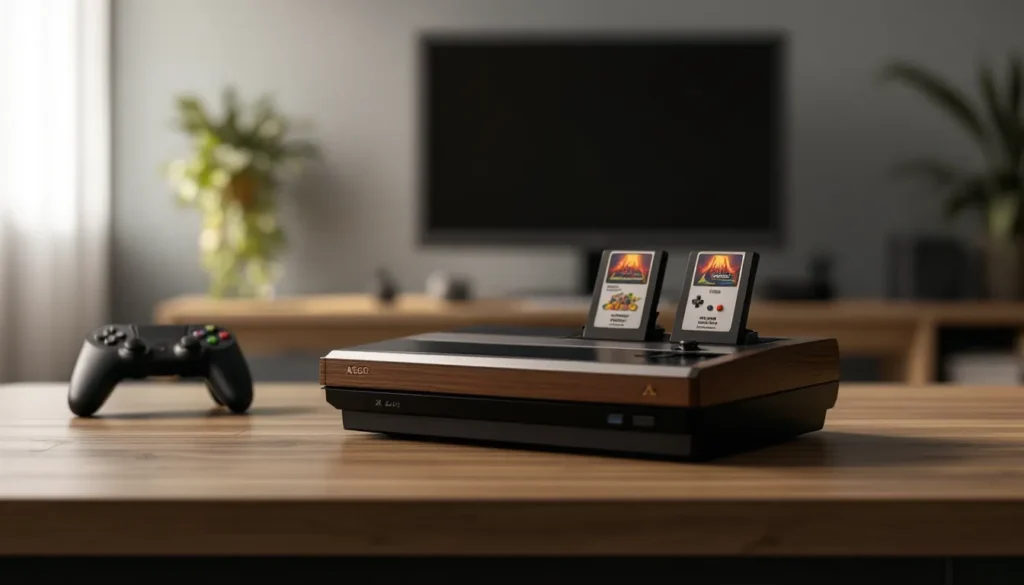
The Atari 2600+ (2023) is Atari’s official re-release of the original 2600, featuring HDMI output, modern controllers, and compatibility with original cartridges. If you own physical carts or can acquire them affordably, this is the authenticity approach. Prices hover around $130, and original cartridges remain relatively inexpensive on the secondary market ($10–40 for common titles).
Retro Hardware: Plug-And-Play Consoles And Arcade Cabinets
Beyond Atari-branded devices, third-party manufacturers offer options. Retro Fighters produces modernized wireless controllers for classic systems. Analogue makes high-end FPGA recreations of classic hardware (pricier but cycle-accurate). MyArcade produces miniature arcade cabinet reproductions with built-in games, fun novelty items, though input quality is often compromised compared to original hardware.
If you’re pursuing original arcade cabinets (a commitment), expect $500–3,000 for a working cabinet depending on condition and rarity. Cabinet restoration is a hobby unto itself. Most casual players will find emulation, official compilations, or the Atari 2600+ sufficiently authentic and far less demanding.
The key: in 2026, playing Atari games is frictionless. No excuse exists for unfamiliarity with these fundamentals.
Why Atari Games Still Matter: Timeless Design And Modern Influence
Atari games are not relics. They’re design textbooks. Playing them teaches lessons that persist across modern gaming, from indie pixel-art platformers to AAA narrative adventures.
Core Game Design Principles That Endure
Atari games operate on constraint-driven elegance. Limited hardware forced designers to ask: what is essential? A joystick with one fire button. A paddle controller. Maybe 16 colors. No voice acting, no cutscenes, no exposition dumps. Within these walls, designers built complete, engaging experiences. Pac-Man doesn’t explain its rules, you learn by playing. Asteroids has zero tutorial: you figure it out in 30 seconds. Modern games bury players in on-screen text, quest markers, and dialogue. Atari games trusted players to learn through play.
This principle resurged with indie developers who embrace limitations intentionally. Games like Celeste (pixel art, tight platforming, difficulty curves borrowed from arcade design) and Braid (puzzle-platformer DNA rooted in Pitfall DNA) consciously reference Atari-era thinking. Constraint breeds creativity.
Atari games also established immediate feedback. Every action produces instant audiovisual response. Press fire: instant shot. Move joystick: instant movement. No lag, no loading, no animations that block player input. That responsiveness is why arcade games feel “tight”, because they must. Modern game design still chases this feeling. The best contemporary controllers, the lowest-latency displays, the best game engines prioritize input-to-output responsiveness as a fundamental design pillar. Atari didn’t invent responsiveness, but it made it non-negotiable.
Replayability through emergent difficulty is another Atari legacy. Most Atari games don’t have predefined level progression. Instead, they escalate in real-time. Pac-Man ghosts get faster. Space Invaders fire more frequently. Asteroids split into more fragments. Centipede accelerates. This systemic difficulty beats scripted progression because it’s unpredictable and adaptive. Modern roguelikes and procedurally generated games owe everything to this philosophy. Each run feels different because the system responds to your performance.
Atari’s Influence On Contemporary Game Development
Atari’s design fingerprints are everywhere in 2026 gaming. Look at Hades (2020): roguelike structure, arcade-tight combat, escalating difficulty, extensive replayability. Look at Hollow Knight: minimalist art direction, exploration rewards, pattern-learning enemies. Look at Vampire Survivors (2022): stream-of-consciousness action, wave-based pacing, simple inputs with complex systems, pure arcade DNA.
Indie studios explicitly emulate Atari constraints as creative choice. Best Retro Games of All Time retrospectives constantly highlight how modern developers use “retro inspiration” not as nostalgia pandering but as structural foundation. Games designed around 8-bit pixel art and chip-tune audio often outperform AAA titles because they deliver focus without bloat.
Even AAA development absorbed these lessons. Arcade-inspired game feel, snappy controls, immediate feedback, punishing but fair difficulty, are standard quality benchmarks. When developers talk about “juice” (visual and audio feedback that makes actions feel impactful), they’re describing what Atari games perfected. Modern accessibility in games, difficulty options, assist modes, customizable input, evolved from arcade design’s inherent unfairness. Games got better at communicating through screens and speakers when they couldn’t rely on story or graphics.
The speedrunning community, esports itself, traces lineage directly to arcade competition. High score leaderboards were invented in arcades. Mastery of frame-perfect inputs, routing optimization, and competitive depth, these emerged from Atari titles. When you watch a speedrunner dissect frame timing or an esports player optimize positioning and resource management, they’re executing principles baked into 1980s arcade design.
Building Your Atari Collection: Tips For New And Experienced Collectors
Collecting Atari hardware and cartridges is rewarding but requires strategy. Prices fluctuate, condition matters, and authenticity is often questioned. Here’s how to build a collection without overspending or acquiring counterfeits.
What To Look For In Used Atari Hardware And Games
2600 consoles vary wildly in condition. The “heavy sixer” (1977–1980 model, six wood-grain sides) and “light sixer” (1980–1982, plastic sides) command premium prices if mint, but working units in fair condition run $80–150. Avoid consoles with yellowed plastic or sticky controllers, cleaning helps, but deeply discolored units often have corrosion inside. Verify that the console powers on and displays an image before purchasing.
Cartridges are where most collector activity happens. Common titles like Pac-Man, Asteroids, and Combat cost $8–15 for working copies. Rarer titles like Air-Sea Battle or Brain Games may reach $30–50. Check the cartridge label for damage, faded labels reduce value, though gameplay is unaffected. Inspect the pins on the cartridge’s underside for corrosion (oxidized or blackened pins indicate age or poor storage). Cartridges with original boxes and manuals command significant premiums ($50+ for common titles, $100+ for rare ones).
Controllers are notorious for degradation. Original Atari joysticks develop worn microswitches and loose potentiometers. If you’re planning to actually play, consider purchasing third-party wireless replacements. If collecting for display, original controllers add authenticity but don’t expect them to be responsive.
Verify authenticity, especially for high-value carts. Unauthorized reproductions exist. Legitimate 2600 cartridges have specific shell construction, label printing, and internal circuitry. Counterfeits often have slightly off dimensions, poor label print quality, or mismatched artwork. Research specific titles before purchasing premium items. Engage with Retro Games List: Discover Timeless Classics communities, veteran collectors can identify counterfeits instantly.
Budgeting For An Authentic Atari Setup
A functional Atari 2600 setup breaks down as follows:
- Console (light sixer): $80–150
- Controllers (2–4 replacements): $40–80
- 10–15 cartridges (common titles): $150–250
- RF switch or HDMI adapter: $10–50
- Total entry level: $280–530
For a more comprehensive collection (30+ cartridges covering diverse genres), budget $800–1,500. Rarer items push this higher.
Cost-saving strategies:
- Buy consoles as lots (console + 5–10 games) rather than piecemeal, usually discounted.
- Focus on common, playable titles first: chase rarity later.
- Shop local Facebook Marketplace and Craigslist before eBay (no shipping markup).
- Consider the Atari 2600+ ($130) for lower upfront cost: it plays original cartridges but requires building a library separately.
- Attend retro gaming swap meets and conventions where dealers negotiate on bulk purchases.
Authenticity matters less for casual players. If your goal is experiencing Atari games, emulation or official compilations cost virtually nothing. If your goal is authentic hardware collection, accept that costs climb and patience pays. The market has stabilized post-2022 boom: prices are reasonable compared to retro gaming’s hype peak. Many titles hover in the “affordable collectible” range, $15–35, where condition and authenticity are achievable without five-figure outlays.
Recent coverage on Retro Games List forums often emphasizes starting small: buy a console, a few beloved games, and expand based on genuine interest, not FOMO. Most veteran collectors built over years, not weeks. Patience and passion trump urgency.
Conclusion
Atari classic games represent more than pixelated nostalgia. They’re the foundational language of interactive design, constraints that bred ingenuity, mechanics that taught entire generations how to play, and principles that persist across every gaming platform today. Whether you’re exploring Pong‘s elegant simplicity, chasing high scores in Pac-Man, or mastering the resource management in Missile Command, you’re engaging with design legacies that still matter.
In 2026, playing Atari games is frictionless. Emulators, compilations, official re-releases, and affordable retro hardware remove every barrier. The question isn’t access, it’s awareness. Understanding Atari is understanding gaming history not as museum piece, but as living DNA.
Start with the essentials: Pong, Space Invaders, Pac-Man, Asteroids. Spend 30 minutes with each. Feel the game design underneath. Notice how quickly you learn the rules, how the difficulty escalates, how each moment demands your full attention. Notice, too, how little modern games have transcended these fundamentals. That’s not failure on modern gaming’s part, it’s validation that Atari got something fundamentally right.
Your next gaming session could begin with 1977. Some of the best play experiences available in 2026 happened 50 years ago. That’s not a time capsule. That’s timeless design. Many gaming publications and content creators worldwide recognize this, sources like Game Rant, GamesRadar+, and GameSpot regularly revisit Atari’s influence on modern gaming. Their analysis reinforces what players discover themselves: Atari didn’t invent games. It invented how games feel.
Get started. The quarter slot is waiting.