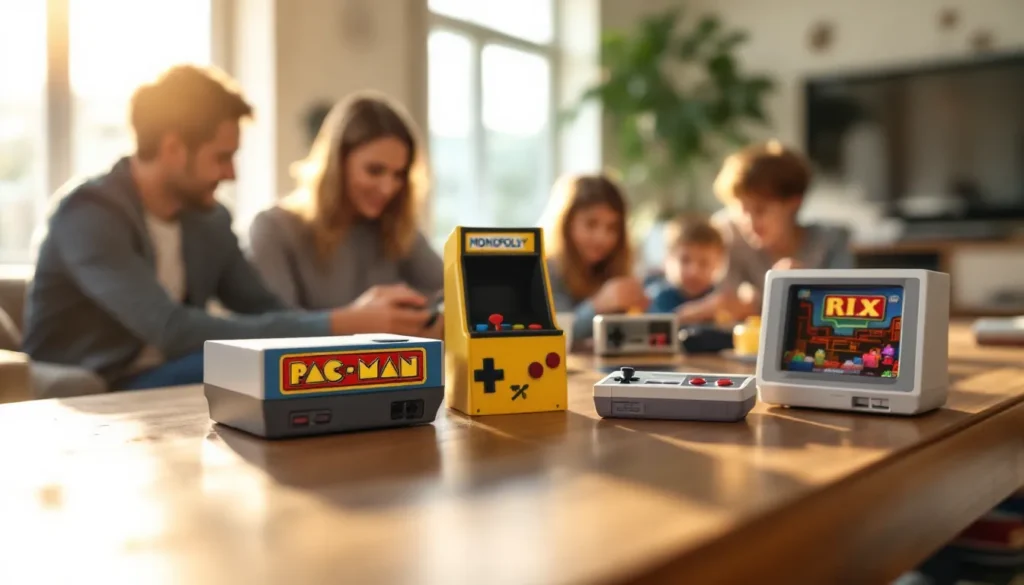
There’s something irreplaceable about classic kids games. Whether you grew up blowing into a Nintendo cartridge, frantically mashing arcade buttons, or rolling dice around a worn board, these games carved out permanent spaces in our childhoods. In 2026, while the industry churns out cutting-edge titles with ray-traced graphics and AI-driven narratives, classic kids games remain as relevant as ever, not just as nostalgic relics, but as genuinely engaging experiences that prove gameplay depth and creativity don’t require next-gen hardware. Parents want to share what they loved with their kids. Younger gamers discover these titles fresh and find them endlessly playable. This guide explores why classic kids games matter today, which titles deserve your attention, and how to actually play them without hunting through sketchy ROM sites.
Key Takeaways
- Classic kids games remain genuinely engaging in 2026 because tight controls, clear objectives, and addictive feedback loops transcend the need for cutting-edge graphics or expensive hardware.
- Arcade games created the first gaming community and esports infrastructure through instant engagement mechanics like Pac-Man, Space Invaders, and Galaga that taught kids pattern recognition and risk assessment.
- Home console classics from Nintendo, Sega, and Atari proved that longer, more complex games could deliver unforgettable experiences through innovative level design and mechanic-shifting power-ups that respected player intelligence.
- Classic kids games work as educational tools because learning happens naturally through tight game mechanics and immediate feedback—not because education was bolted onto entertainment.
- Legal access to classic kids games in 2026 is easier than ever through Nintendo Switch Online, official re-releases, PC emulation (if you own the originals), and plug-and-play collections that cost $60–$100.
- Classic kids games teach both children and game designers what interactive entertainment fundamentally requires: fair difficulty curves, transparent rules, and replayability that feels rewarding across different skill levels.
Why Classic Kids Games Still Matter Today
Classic kids games have staying power that most modern releases won’t touch. They teach what game design fundamentally requires: tight controls, clear objectives, and addictive feedback loops, none of which demand expensive motion-capture rigs or sprawling open worlds. A kid picking up Super Mario Bros. for the first time in 2026 experiences the same revelation it provided in 1985: precise platforming where every jump feels earned, where timing matters, and where difficulty scales perfectly.
The simplicity is the feature, not the limitation. Without tutorial pop-ups or quest markers, classic kids games respected player intelligence. They expected trial and error. They rewarded exploration. This directness is increasingly rare now, making games like Pac-Man, Donkey Kong, and The Legend of Zelda feel refreshingly immediate.
Modern research backs this up: games with straightforward mechanics and replayability improve focus and problem-solving in ways designed-by-committee AAA titles sometimes miss. Classic kids games offer accessibility across skill levels, a five-year-old and a forty-year-old can both find challenge and fun in the same game, just at different competency points.
They’re also platform-agnostic in a way that matters. Want to play Tetris on Game Boy, NES, mobile, or arcade? It’s fundamentally the same game, your muscle memory transfers. This consistency is gold for families spanning multiple devices. Plus, the lack of online-only requirements, battle passes, or live-service mechanics means these games exist in their final, stable form. No seasonal resets. No server shutdowns. Just you, the game, and the challenge.
The Golden Age Of Arcade Games For Children
Arcade games were the first mass-market gaming experience for kids, and they dominated the 1980s landscape. These weren’t just diversions, they were cultural touchstones. The arcade cabinet was the ultimate peer-pressure machine: gather a crowd, pump in quarters, chase the high score. The format created games designed for instant engagement, immediate feedback, and that “one more try” loop that kept quarters flowing.
What made arcade games so effective for kids was their directness. No story cinematics, no convoluted control schemes. Galaga meant “dodge and shoot.” Space Invaders meant “survive the descent.” Frogger meant “reach the other side.” The design philosophy was uncluttered: one core mechanic, escalating difficulty, and your name on a leaderboard if you could crack the top scores.
Arcade cabinets created the first esports infrastructure too. Kids would stake their reputations on scores, memorize patterns, study the RNG quirks of specific machines. The social element was inseparable from the mechanical one. You weren’t just playing: you were competing for status in real-time, in public.
Iconic Arcade Titles That Shaped Childhood
Pac-Man (1980) is the obvious anchor. A simple concept, navigate a maze, eat dots, avoid ghosts, that somehow created infinite depth. Kids learned pattern recognition, route optimization, and risk assessment. The four ghost AI patterns became legendary. Success on Pac-Man meant something.
Space Invaders (1978) essentially created the arcade industry’s commercial viability. Rows of aliens descending, getting faster. Simple, effective, panic-inducing. It taught timing and aim without any hand-holding.
Donkey Kong (1981) was the first true character-driven arcade game. Jump over barrels, rescue the girl, repeat with harder patterns. It launched Mario (originally Jumpman) and proved that arcade games could have personality and progression.
Galaga (1981) perfected the shoot-em-up formula. The alien formations, the ability to capture your own ship for a temporary dual-fire state, the escalating challenge, it’s a masterclass in arcade design. Kids spent incalculable hours chasing scores.
Ms. Pac-Man (1982) wasn’t just a gender-swapped reskin: it featured faster movement, new maze layouts, and altered ghost behavior. It proved the formula could evolve without losing what made the original work.
Dig Dug (1982) introduced puzzle-action hybrids to arcade audiences. Dig tunnels, inflate enemies until they burst. Simple mechanics, emergent complexity.
These titles, playable on thousands of cabinets across arcades worldwide, created the first gaming community. They’re still playable, often in physical arcade bars, on compilations, or through legitimate emulation, and they hold up because they aren’t relying on technological novelty. They’re relying on genius design.
Home Console Classics Every Kid Should Play
Arcade games got gaming on the map, but home consoles made it a permanent fixture. The NES, Sega Genesis, SNES, and early PlayStation brought the arcade into living rooms and introduced kids to gaming at scale. These systems hosted games that defined entire generations of childhood.
Home consoles allowed for deeper games than arcade formats could support. No quarter requirement meant designers could build longer experiences. Saving and loading changed everything, games no longer needed to artificially cap themselves into 30-minute sessions. This opened narrative possibilities and complexity that shaped what gaming could be.
Nintendo’s Defining Contributions To Kids Gaming
Nintendo’s handiwork is impossible to overstate. The NES literally saved the video game industry after the 1983 crash through disciplined game design and aggressive marketing. Super Mario Bros. (1985) is the most important launch title ever made, it taught a generation that video games were fun, teachable, and replayable infinitely.
The genius of Super Mario Bros. was level design. Each world introduced one new mechanic, mastered it across multiple levels, then built on it. Kids learned to explore, to understand momentum, to recognize that slightly earlier jumps worked better than late ones. No tutorials. The game was the tutorial through careful design.
The Legend of Zelda (1986) proved games could be adventure-game narratives without rigid story sequences. You had a sword, a shield, a dungeon to explore, and absolute freedom in how to approach it (mostly). The sense of discovery was intoxicating for kids who grew up on linear platformers.
Super Mario Bros. 3 (1990) is arguably the peak of 2D platformer design. New power-ups that weren’t just stat boosts but fundamental mechanic shifters (raccoon tail flying, frog suit swimming). Level design that rewarded curiosity and punished carelessness perfectly. It’s still the standard for how platformers should feel.
Kirby’s Dream Land (1992) showed that not every kid game needed brutal difficulty. It was colorful, intuitive, and most importantly: accessible. The copy ability mechanic meant each enemy encounter taught the player new movement options. It proved difficulty scaling could include ease modes without sacrificing the core design.
The Legend of Zelda: A Link to the Past (1991) on SNES expanded the formula into vast overworlds, multiple dungeons with interconnected puzzles, and a sense of genuine exploration. Kids could get lost in Hyrule for hours without a quest marker in sight.
Super Metroid (1994) is a masterpiece of world design and progression. The map is massive but comprehensible. Each ability acquired opens new areas, creating that perfect learning curve. Kids had to develop spatial memory, combat timing, and resource management.
These weren’t easy games, but they were fair. They respected player skill and offered satisfaction proportional to effort.
Sega And Atari Classics For Young Players
Sega came late to the console market but brought the arcade directly to home systems through the Master System and Genesis. Sonic the Hedgehog (1991) was Sega’s answer to Mario, a mascot, a franchise, a statement. The Genesis delivered arcade-quality graphics and speed. Sonic games were fast, aggressive, and skill-based. Where Mario was about precision, Sonic was about momentum and reading patterns at high speed.
Sonic the Hedgehog 2 (1992) perfected the formula with tight controls, two-player options, and level design that rewarded speed while punishing carelessness. Kids loved the adrenaline-spike gameplay.
Alex Kidd in Miracle World (1986) for Master System was a quirky platformer that combined action with rock-paper-scissors boss battles. Weird, but it worked for Sega’s young audience.
Atari 2600 games have a different flavor entirely, more basic visually, but often more creative mechanically. Pitfall. (1982) was an exploration platformer with a timer and hazards that created genuine tension. Adventure (1980) is considered the first action-adventure game. The castle’s rooms, the keys, the dragons, it was abstract but imaginative.
Breakout (1976) was simple, paddle, ball, bricks, but endlessly replayable. That mechanic is still used in mobile games today. Atari games were often more experimental, less polished, but that experimentation revealed core design principles that modern games are still learning from.
These systems created the console wars that defined childhood for millions: Team Sega or Team Nintendo, each defending their library fiercely. That competitive spirit around game libraries is a legacy these systems created.
Board Games And Tabletop Classics For Family Fun
Not all classic kids games plug into screens. Board games and tabletop games have been teaching kids strategy, math, negotiation, and luck assessment for decades, long before video games existed. The difference is they bring families together at a table without a glowing screen mediating the interaction.
Monopoly (1935, but ubiquitous through childhood) teaches negotiation, math, and patience. Yes, it’s long. Yes, players get frustrated. That’s partly the point, it mirrors real economic principles through gameplay, unpleasant as those can be.
Risk (1959) introduced kids to strategy, territory control, and risk-versus-reward calculations. “Should I attack from three armies or five?” creates tactical depth for players aged eight and up.
Scrabble (1938) makes word-building competitive and educational. Kids learn vocabulary, spelling, and spatial strategy. It works across age groups because there’s no luck element, just vocabulary knowledge and planning.
Sorry. (1934) uses simple roll-and-move mechanics with cards that create unpredictability. The “Sorry.” mechanic (bumping opponents back to start) teaches kids that sometimes luck cancels out good planning.
Candyland (1949) is the first board game many kids play. No dice, no reading required (the cards have pictures), just move along a path based on card draws. It’s pure luck and imagination.
Chutes and Ladders (1943) introduced probability to kids, understanding that some outcomes are more likely, some squares send you backward, some forward.
These games are still printed, still played, still teaching the same lessons. They work because the mechanics are transparent: you can see every player’s position, understand the rules immediately, and feel the tension of every roll or card draw. There’s no hidden information creating frustration, no randomness that feels unfair because the stakes are transparent.
Tabletop games also create memories differently than video games. A family playing Monopoly on a rainy afternoon, the negotiation that happens, the dramatic comeback, those become stories retold for years. Video games create those moments too, but tabletop games make the social interaction the primary mechanic, not a secondary one.
Educational Games That Entertained While Teaching
Some of the best classic kids games didn’t feel like education at all. They were games first, and learning happened as a side effect.
Reader Rabbit (1986) and The Magic School Bus series turned reading comprehension into adventure. Kids solved puzzles by correctly identifying words or answering comprehension questions. The payoff was game progression, not grades.
Math Blaster (1983) made arithmetic timed and competitive. Shoot asteroids by solving equations correctly. It wasn’t a drill disguised as a game, the pacing, the pressure, the consequence of failure (losing a ship) made math feel high-stakes and engaging.
Oregon Trail (1985) snuck in geography, history, and resource management. Kids learned about westward expansion while managing food, ammunition, and party health. The random dysentery deaths became infamous, a teaching moment wrapped in humor.
Number Munchers (1983) used simple grid-based gameplay to teach number recognition and concepts. Eat the correct numbers, avoid the munchers. The feedback loop was immediate: wrong answer = you lose.
Carmen Sandiego (1985) rewarded geographic knowledge. Players hunted a criminal across countries and cities, but you couldn’t catch them without knowing where their hideout was. The game required research and learning.
Spelling Bee and similar titles used word games to teach spelling and vocabulary. The incentive was high-score competition, not parental approval.
These games worked because they followed the same design principles as entertainment games: tight feedback loops, clear progression, and consequences tied to player action. The learning happened because the mechanics required it, not because someone bolted education onto entertainment. Compare this to modern “educational” games where learning is the point and fun feels incidental, these classics proved that education-first thinking actually fails both education and entertainment.
They also respected kids’ intelligence. Kids knew they were learning something, but the game was good enough that they didn’t resent it. That’s the balance modern educational games struggle with.
How To Play And Preserve Classic Kids Games Today
The great challenge of classic kids games is access. Many are no longer in print. Cartridges degrade. Arcade cabinets break. Companies that made them sometimes don’t exist anymore. But there are legitimate, legal ways to experience these games in 2026.
Emulation And Legal Ways To Access Retro Titles
Emulation is the most practical path. Emulators are software that replicates old hardware, a NES emulator runs NES ROM files the same way original hardware would. This is where many gamers access classics legally.
Nintendo Switch Online ($20/year) is the most family-friendly option. It includes a growing library of NES and SNES classics. The service offers save states, rewind functionality, and online multiplayer for some titles. It’s fully legitimate and provides revenue to Nintendo.
Game Pass on Xbox and PC includes some classic titles, adding new ones regularly. It’s not comprehensive for retro gaming, but it’s a legal way to sample classics alongside modern games.
PC emulation through projects like Dolphin (GameCube/Wii emulator) or Citra (3DS emulator) is legal if you own the original cartridges or discs, the legality of ROM distribution is murkier. The safe approach: dump your own ROMs from games you own, or use emulation services that have licensed the content. The cool math games retro bowl provides a bridge between nostalgic mechanics and modern web accessibility.
Arcade emulation is similar. MAME (Multiple Arcade Machine Emulator) can run thousands of arcade ROMs legally if you own them. Many arcades in 2026 actually use MAME-based cabinets with licensed ROM packs because original hardware reliability becomes impossible after 40+ years.
A practical note: emulation quality varies wildly. Some emulators introduce input lag that makes rhythm-dependent games unplayable. Others introduce audio distortion. Research the specific emulator-game combination before expecting perfect accuracy. Console emulation is generally more reliable than arcade emulation.
Remakes and re-releases are another legitimate angle. Many classic kids games have official modern ports. Super Mario Bros. appears on nearly every Nintendo system. Sonic games are available on multiple platforms. These versions often include extras like achievements, rewind features, or quality-of-life improvements. They cost money, but you’re supporting the original developers (or their successors).
Homebrew communities have created new games using classic engines. These are free, often high-quality, and created with explicit permission or built on dead franchises where rights are unclear. Exploring homebrew titles shows how the design principles of classic kids games still inspire creators.
Flash game archives and web-based platforms sometimes host classics legally. The Internet Archive’s Wayback Machine has preserved defunct Flash games (though Flash is deprecated now). Sites like itch.io host thousands of free indie games inspired by classic design philosophies, offering the spirit of these games even if not literal recreations.
Building A Retro Gaming Collection For Kids
Physical cartridges and hardware still exist, though prices have inflated. Buying original hardware, a working NES, Genesis, or SNES, plus games can cost $200-$1000 depending on quality and completeness. But it’s not necessary for kids to experience these games.
Plug-and-play collections offer a middle ground. Nintendo releases official classic console replicas (NES Classic Edition, SNES Classic Edition, Game Boy Pocket, etc.) that come pre-loaded with 30+ games. Expect $60-$100 for these, and the game selection is curated (sometimes controversially, fans always want more).
If building a physical collection, prioritize games, not hardware condition. A yellowed, dusty cartridge that works perfectly is better than a mint-condition one that doesn’t. Test everything before buying. Cartridges can be cleaned, recapped (replacing aging capacitors), and sometimes reprogrammed if they’ve corrupted. The retro gaming community has repair expertise if you’re willing to learn.
For families, the software-based approach is more practical. A modest gaming PC or Nintendo Switch, emulation software or subscriptions, and you can access hundreds of classics legally. You can play game consoles for kids with modern convenience while respecting the originals.
Don’t gatekeep. Kids who’ve only ever played these games through emulation have still experienced genuine games. The platform matters less than the design. A kid playing Super Metroid on a Switch or through emulation learns the same lessons as one with an original SNES cartridge.
Preservation efforts matter too. Projects like the Video Game History Foundation and the Digital Preservation Network work to archive and maintain these games. Supporting these organizations helps ensure classics remain accessible even as original hardware ages beyond repair.
The classic games on Steam platform has also made many classics available legally and affordably, creating an accessible entry point for new generations.
Conclusion
Classic kids games endure because they’re built on principles that never get old: clear objectives, fair difficulty curves, immediate feedback, and replayability. These aren’t relics that only matter for nostalgia, they’re genuinely great games that teach both players and designers what interactive entertainment can be.
The landscape in 2026 makes accessing these games easier than it’s ever been. Whether through legal emulation, subscription services like Nintendo Switch Online, official re-releases, or physical hardware, every parent and kid curious about where gaming came from has a legitimate path to experience these titles.
The best reason to play classic kids games isn’t sentimentality. It’s that your five-year-old will react to Super Mario Bros. exactly the way you did at that age. A teenager will discover that Tetris teaches spatial reasoning in ways no tutorial can match. These games work across ages because they’re fundamentally well-designed.
In an era where games are increasingly designed by algorithm and A/B testing, there’s something refreshing about games where a small team’s creative vision is obvious in every frame. Start somewhere. Grab a copy of The Legend of Zelda, press start, and remember why you fell in love with gaming in the first place. Your kids might surprise you by falling in love for the exact same reasons.