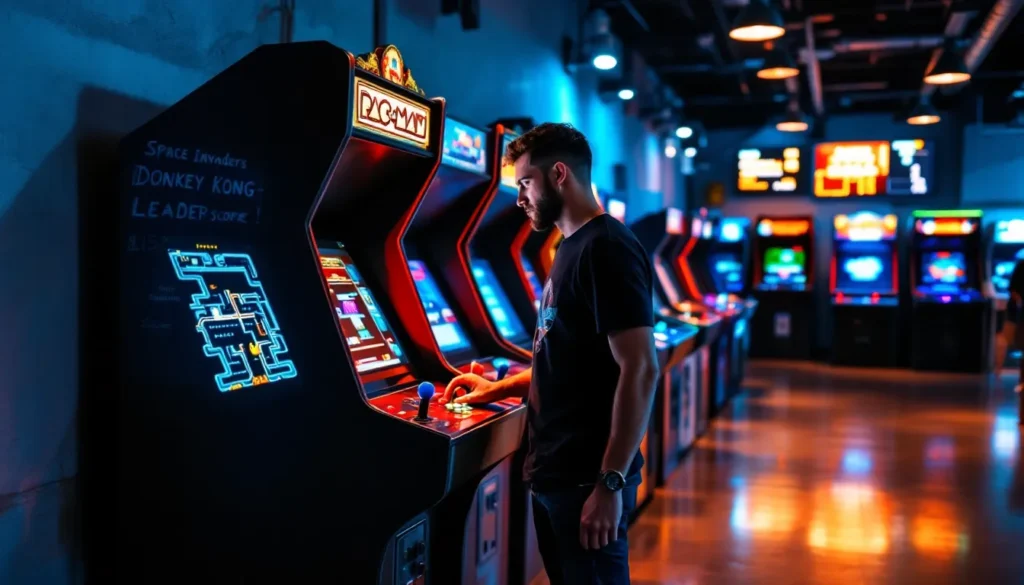
Arcade gaming in the 1980s wasn’t just entertainment, it was a cultural phenomenon that defined a generation. Walk into any retro arcade today, and you’ll see why. Players still gravitate toward those same cabinets that packed quarters into machines for hours, chasing high scores and perfecting their skills. Whether it’s the rapid-fire precision of shooting galleries, the maze-based strategy of classic puzzle games, or the head-to-head intensity of fighting games, the appeal of 1980s arcade games and 80’s arcade games hasn’t faded. In fact, the most popular arcade games continue to draw both longtime enthusiasts and new players discovering these gems for the first time. This guide explores the timeless classics that shaped gaming, explains why they still matter, and shows you where to experience them in 2026.
Key Takeaways
- Popular arcade games from the 1980s remain timeless due to their immediate, skill-based gameplay with zero learning curve and elegant design that modern titles struggle to replicate.
- The cultural impact of arcade gaming established competitive play, esports, and high-score chasing as legitimate pursuits, with games like Pac-Man, Space Invaders, and Street Fighter becoming global icons.
- Modern indie games, roguelikes, and mobile titles directly inherit arcade DNA through the ‘one-more-run’ progression system and pattern-recognition mechanics that arcade games pioneered.
- You can experience classic arcade games through multiple accessible methods today: emulation platforms like MAME, official compilations such as Pac-Man Museum, retro arcades, and online tournaments.
- Mastering arcade games requires studying enemy patterns and AI behaviors rather than relying on reflexes alone, making these 80s arcade games as much about strategy and puzzle-solving as action.
What Makes Arcade Games Timeless Classics
Arcade games from the 80s possessed something modern titles often struggle to replicate: immediate, skill-based gameplay with zero learning curve. You didn’t need a tutorial. You inserted a coin, pressed start, and understood the objective in seconds. That directness is part of their genius.
Simplicity paired with depth separates the truly great arcade games from the forgettable ones. Pac-Man isn’t just a dot-eating simulator, it’s a game about pattern recognition, timing, and resource management. Space Invaders forces split-second decisions under mounting pressure. These games demand mastery but reward it instantly with higher scores, longer survival, and bragging rights.
Another crucial element is the feedback loop. Arcade cabinets gave immediate, visceral responses: satisfying controller clicks, booming sound effects, and visual explosions that celebrated your success or punished your failures. There’s no hidden RNG punishing you after two hours of grinding. Every outcome stems directly from your input.
The arcade games list from the 80s also benefited from hardware constraints that forced creativity. Limited processing power meant developers focused on addictive core mechanics rather than bloat. That constraint produced some of gaming’s most elegant designs. Modern remasters and collections prove these games lose nothing in translation to modern systems, they’re as engaging on a phone as they were on a cabinet in 1980.
The Golden Era of Arcade Gaming
Early Pioneers That Changed Gaming Forever
The arcade scene of the late 1970s and early 1980s was explosive. Space Invaders (1978) didn’t invent arcade gaming, but it weaponized it, proving that cabinets could drive genuine cultural obsession. Arcade operators couldn’t keep machines stocked fast enough. Within two years, arcades had become the primary social hub for gaming.
Pac-Man arrived in 1980 and did something unprecedented: it broadened arcade appeal beyond the aggressive male demographic. The game’s colorful protagonist and approachable mechanics made it accessible to families and casual players. It became a phenomenon that transcended gaming, merchandise, TV shows, and cultural references followed. The success proved that arcade games didn’t need ultraviolence or complex narratives to dominate the market.
Then came Donkey Kong (1981), which introduced the platform-jumping mechanic and established the “damsel in distress” narrative template that would define 1980s gaming. Jumpman (Mario’s original name) had to navigate obstacles, avoid enemies, and rescue his girlfriend. It was simple, iconic, and spawned an empire.
Galaga (1981) refined the space shooter formula with new tactics: enemies that dive-bombed players, capture mechanics, and patterns players could learn and counter. It’s why Galaga remains one of the most played arcade games on any list of arcade games from the 80s.
The Rise of Competitive Play and High Scores
Early arcades weren’t just about personal achievement, they became competitive arenas. Leaderboards, either on-screen or physically posted in arcades, transformed arcade gaming from casual entertainment into sport. Players traveled between locations to challenge local champions, and arcade operators recorded champion names and scores.
The Donkey Kong competitive scene became serious business. Tournaments emerged, rivalries developed, and high-score chasers treated arcades like professional venues. Documentary The King of Kong (2007) later captured this era’s intensity, but the obsession was real and happening throughout the 1980s.
Galaga, Ms. Pac-Man, and Tempest all spawned dedicated communities of high-score hunters. The pursuit wasn’t about grinding, it was about mastering patterns, developing muscle memory, and outsmarting the game’s AI. Players would spend months learning perfect routes, memorizing enemy patterns, and shaving milliseconds off their times.
This competitive culture normalized the arcade as a serious gaming space. By the mid-1980s, arcade culture had morphed into esports before esports had a name. Players achieved celebrity status within their communities, and sponsorships followed. The stakes felt real because the competitions were real.
Must-Play Arcade Legends Everyone Should Experience
Action-Packed Shooters and Fast-Paced Classics
If you’re building a list of arcade games to experience, shooters are non-negotiable. Space Invaders remains the foundation of the genre. The downward-creeping aliens, the shield mechanics, and the ever-increasing difficulty create tension that modern games rarely achieve even though having exponentially better hardware.
Galaga is the refined evolution. It takes the shooter formula and adds depth: diagonal movement, enemy patterns that loop predictably, and a capture mechanic where enemies can snag your ship and give it to another enemy. The strategy layer transforms it from a twitch game into something methodical and cerebral.
Centipede (1980) takes the vertical-shooter template sideways (literally). The centipede moves horizontally, breaks apart when shot, and regenerates from the top. The addition of mushrooms creates coverage and forces positioning changes. It’s a small tweak that transforms the entire experience.
Asteroids (1979) deserves mention even though being pre-80s, but its influence permeates the decade. The vector-based graphics, the rotation mechanics, and the hyperspace button created a unique control scheme that rewarded finesse over reflexes.
Defender (1980) cranked the speed up to breakneck levels. Your tiny spaceship moves laterally while protecting humanoids on the ground. The enemies move fast, the space wraps horizontally, and the game demands constant repositioning. It’s challenging enough that it still frustrates modern players.
Maze Games and Strategic Gameplay
Pac-Man defined the genre and remains unmatched. The four ghosts, Blinky, Pinky, Inky, and Sue, each have distinct AI patterns. Blinky chases directly. Pinky aims ahead. Inky uses diagonal calculations. Sue patterns seem almost random. Learning these behaviors is how players survive longer.
Ms. Pac-Man (1981) added moving power pellets and new maze designs, preventing players from relying on memorized loops. It’s widely considered the superior game because it demands real-time adaptation rather than rote pattern execution.
Dig Dug (1982) inverts the chase dynamic. You’re digging tunnels while enemies pursue from above. Your weapon inflates enemies until they pop or crushes rocks to eliminate threats. It’s strategic, do you tunnel toward enemies or away? Do you risk a power-up?
Pengo (1982) combines Pac-Man mechanics with an ice-block pushing puzzle element. You navigate mazes while moving ice blocks to trap enemies. It sounds like a minor addition, but it transforms the game from pure chase mechanics into spatial puzzle-solving.
Fighting Games That Defined a Genre
Street Fighter (1987) arrived without fanfare and relatively low impact initially, but its sequel, Street Fighter II (1991), became the mega-hit that defined fighting games. The roster of distinct characters, each with unique move sets and playstyles, meant that Street Fighter II demanded both mechanical skill and character matchup knowledge.
Mortal Kombat (1992) leveraged digitized sprites and gore to become a cultural sensation and occasional political controversy. The “Fatality” mechanic, finishing moves that executed defeated opponents, became an iconic signature. Both games are technically early 1990s, not 1980s, but they represent the natural evolution of arcade gaming and the fighting-game subcategory that emerged in the late 80s.
Before those titans, Karate Champ (1984) was the first 1v1 fighting game. Two pixel-art martial artists faced off, each with a small move set. The hit detection was inconsistent, and the mechanics were primitive, but it proved the formula worked.
Punch-Out.. (1984) gave us Mike Tyson and a vertical fighting-game layout. Rather than simultaneous turns, Punch-Out.. was reactive: you dodged, waited for openings, and countered. Each opponent had distinct patterns, and the skill ceiling was exceptionally high. Speedrunners still chase records on emulated versions.
Arcade Games That Influenced Modern Gaming
How Classic Arcade Mechanics Shaped Today’s Games
If you examine modern indie games, roguelikes, and mobile titles, you’ll find arcade DNA everywhere. The progression system of arcade games, survive longer, push higher into difficulty, chase a high score, is the exact loop driving games like Hades, Celeste, and Dead Cells. Developers realized that the old formula works because it taps into intrinsic motivation: the drive to get better, to beat your previous attempt, to prove mastery.
That’s why Retro Games List: Discover Timeless Classics That Shaped Gaming History remains so relevant. The core mechanics from 1980s arcade games translate directly into 2026’s most celebrated indie darlings.
The “one-more-run” mentality originated in arcades. You had limited resources (lives or coins), so every mistake mattered. That tension created engagement that grinding sessions and infinite respawns never could. Modern roguelikes and roguelites borrowed this friction model because it works.
Level design philosophy also traces back to arcades. Early games couldn’t afford sprawling worlds, so every screen mattered. Designers packed screens with secrets, alternate routes, and carefully balanced difficulty curves. That’s the exact lesson indie developers have relearned: constraints breed creativity.
Pattern recognition, the core skill arcade games tested, remains relevant across genres. Fighting games, rhythm games, bullet-hell shooters, and puzzle games all reward learning patterns and executing against them. No amount of graphical fidelity changes the fundamental appeal of mastering a game’s systems.
The Cultural Impact of Arcade Gaming
Arcades weren’t just entertainment venues, they were third spaces. Teenagers hung out after school. Competitive communities formed. Casual players socialized over multiplayer cabinets. That culture normalized gaming as a legitimate social activity before home consoles made gaming solitary and family-focused.
The arcade era produced icons that endure: Mario became a plumber in the 1980s and remains one of gaming’s most recognizable characters. Pac-Man transcended gaming into pop culture in ways few characters have matched. Donkey Kong spawned a multi-billion-dollar franchise. These weren’t accidents, they were products of arcade games capturing imaginations.
Arcade culture also established tournament gaming and esports as legitimate pursuits. Competitive Street Fighter and other fighting games led directly to modern esports ecosystems. The narrative of beating regional champions to compete nationally? That’s an arcade-era invention.
Also, arcades created the business model of the free-to-play game. Quarters were monetization. The model of “free entry, pay-for-continued-play” is essentially the arcade cabinet model adapted to digital platforms. That’s why battle passes, seasonal content, and continuous balance updates feel natural to modern gamers, they’re arcade principles translated to the digital age.
Atari Classic Games: Relive the nostalgia and understand the hardware that made this era possible. Atari hardware constraints forced innovation that still influences game design today.
Where to Play Popular Arcade Games Today
Retro Arcades and Emulation Communities
Retro arcades have made a genuine resurgence. Cities worldwide now feature barcades, bars with functioning arcade cabinets, where adults relive their youth while socializing. Locations like Dave & Buster’s maintain vintage cabinets alongside newer games, creating spaces where both 1980 arcade games and modern titles coexist.
Emulation has democratized arcade access. Platforms like MAME (Multiple Arcade Machine Emulator) and RetroPie offer access to thousands of arcade titles on modern hardware. Enthusiasts build custom arcade cabinets using Raspberry Pi boards and emulation software, accurately replicating the original experience with original controller layouts and arcade-accurate display options.
Consider Best Retro Games of for curated collections that include playable emulated versions. These communities maintain accuracy down to individual ROM versions, ensuring you’re playing the exact arcade release rather than home console ports that often differed significantly.
Online tournaments and competitive communities have emerged around emulated arcade games. The Twin Galaxies leaderboards maintain official records for classic arcade scores, and GameSpot regularly covers competitive arcade events. Players compete globally on emulated cabinets, with some taking runs seriously enough to invest in arcade-accurate controllers and display setups.
Modern Remasters and Official Rereleases
Major publishers have re-released classic arcade games in official compilations. The Pac-Man Museum, Namco Museum, and Atari 50 collections bundle dozens of titles on modern platforms. These releases often include original ROMs rather than re-engineered versions, ensuring authenticity.
Collection quality varies significantly. Some compilations include behind-the-scenes documentaries, development commentary, and museum-style exhibitions. Others are bare-bones dumps. Research individual compilations before purchasing.
My Arcade Go Gamer showcases modern portable arcade devices that include classic titles pre-loaded. These plug-and-play devices target casual players seeking nostalgia without emulation complexity.
Steam has become a legitimate platform for classic arcade titles. Classic Games on Steam: Relive Nostalgia with Timeless Titles offers both original releases and modern interpretations. Developers have created arcade-style games inspired by classics, and official remasters alongside the original ROMs give players options.
Mobile gaming deserves mention. Most major arcade games are available on iOS and Android through official channels or legitimate third-party publishers. Touchscreen controls aren’t ideal for reflex-heavy games, but they’re functional for maze games and turn-based arcade experiences.
Consider Big Red’s Retro Games: for community-curated selections and recommendations on where specific games are currently available and worth your time.
Tips for Getting the Most Out of Arcade Gaming
Mastering Gameplay and Chasing High Scores
Approach arcade games as puzzles rather than tests of pure reflexes. Study enemy patterns before engaging. Watch how Galaga enemies move, they patrol in precise formations before diving. Learn that pattern, and you’ll know when to move defensively versus offensively.
In maze games like Pac-Man, memorize the ghost AI behaviors. Blinky is predictable, he chases your current position. Inky uses diagonal calculations. Pinky aims ahead. Sue’s patterns seem erratic because the AI has a flawed target calculation. Understanding these differences lets you manipulate their movements.
High-score chasing requires intentional practice. Set specific targets: “This session, I’m reaching level 3 without dying.” Progress incrementally. Death isn’t failure, it’s data. Each loss teaches you what went wrong.
Use the right hardware. Emulation with modern controllers works, but arcade-accurate stick and button layouts make a difference. Your muscle memory developed on actual arcade hardware transfers better to authentic controllers. Many serious players invest in arcade-quality joysticks for home emulation.
Play in short sessions initially. Arcade games are taxing, constant vigilance and rapid inputs exhaust mental resources. Better to have three 20-minute sessions where you’re sharp than one 60-minute session where fatigue kills your performance.
Watch streams and videos of high-level play. Twinfinite and other gaming outlets cover arcade speedruns and competitive play. Observing expert execution shows techniques and strategies you might not discover solo.
Join online communities. Subreddits like r/retrogaming and specialized forums discuss strategies, optimal routes, and pattern-learning techniques. Competitive players share frame-perfect execution details and high-score verification standards.
Building Your Own Arcade Collection
Start with games you genuinely enjoy, not “must-plays.” Personal preference matters more than critical consensus. If Defender frustrates you but Centipede clicks, build around Centipede and similar games.
Emulation is the practical entry point. Install MAME or RetroPie on a cheap computer or Raspberry Pi. Add a quality joystick (Sanwa or Happ parts are arcade-standard). This setup costs under $200 and grants access to thousands of games.
If budget allows, consider bartop cabinets. Companies sell pre-built or kit-based mini arcade cabinets with 100+ games pre-loaded. They’re not cheap (typically $300–$800), but they’re authentic experiences without the footprint of full arcade cabinets.
For serious collectors, sourcing original arcade cabinets requires capital and space. Original Pac-Man or Galaga cabinets sell for $2,000–$5,000+ depending on condition. Restoration, repairs, and maintaining working CRT monitors add costs. This level of collecting is a hobby in itself, expect to spend as much on maintenance as acquisition.
Comparisons matter. Retro Fighting Games: Why They Still Captivate Gamers Today breaks down fighting game subcultures specifically, but the collecting principles apply across genres: understand what version you want (original arcade ROM vs. home port), verify authenticity, and build collections thematically or by preference rather than completionism.
Connect with collector communities. Facebook groups, Discord servers, and forums specializing in arcade games offer advice on sourcing legitimate copies, identifying reproduction boards, and troubleshooting hardware issues. These communities also organize trades and sales.
Remember that playing matters more than owning. A well-maintained emulation setup provides better access than an ornamental cabinet that breaks every two months. The goal is enjoying games, the method is secondary.
Conclusion
The enduring appeal of classic arcade games lies in their elegant simplicity and unmatched depth. Decades after their release, the most popular arcade games continue proving that great design transcends technology. Whether you’re rediscovering 1980s arcade games for the first time or revisiting favorites, the experience remains revelatory: arcade games taught players to master systems, compete seriously, and find genuine joy in skill expression.
The arcade era wasn’t just about entertainment, it was the foundation of modern gaming culture. The mechanics, communities, and competitive frameworks established in arcades permeate contemporary gaming across all platforms. Understanding 80s arcade games and the golden era of arcade gaming provides context for why today’s games work the way they do.
You don’t need expensive cabinets or elaborate setups to experience the magic. Emulation, official re-releases, and growing retro arcade venues make these games more accessible than ever. Start with the classics everyone knows, explore beyond the obvious, and discover why players are still captivated by these decades-old designs. The classics earned their status, they’re waiting for you to understand why.