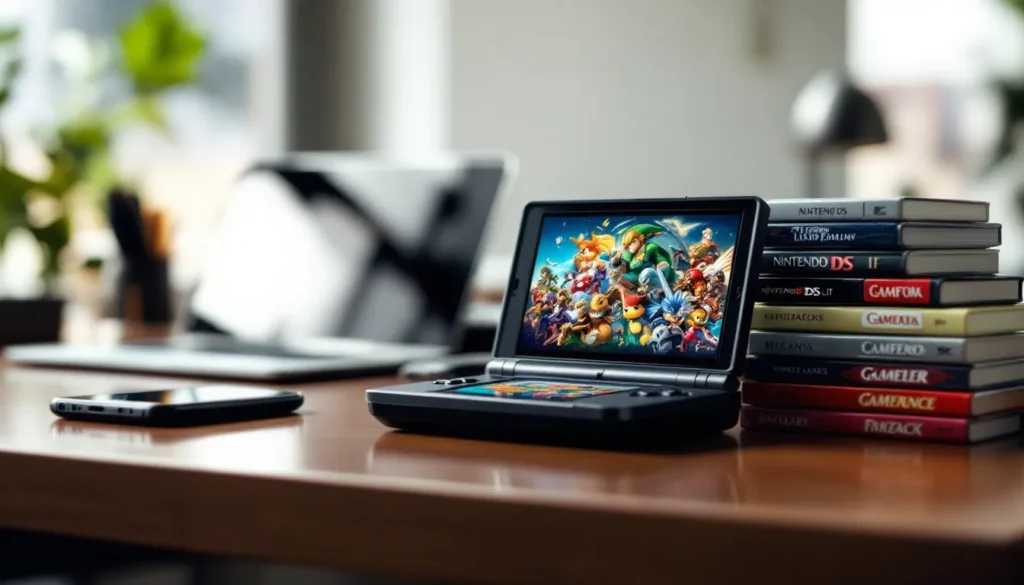
The Nintendo DS revolutionized handheld gaming when it launched in 2004, and more than two decades later, its library remains untouchable. With dual screens, touch controls, and backward compatibility with Game Boy Advance titles, the DS created a playground for innovation that bigger, flashier platforms still can’t replicate. Whether you’re hunting down classic DS games you missed or rediscovering titles that shaped your childhood, the console’s catalog holds up remarkably well. Unlike modern games obsessed with open worlds and ray-tracing, DS games focused on tight design, creative mechanics, and pure playability, qualities that age far better than cutting-edge graphics ever will. If you’re serious about gaming history, the DS isn’t just a museum piece: it’s a masterclass in what happens when hardware constraints force developers to get creative.
Key Takeaways
- Top Nintendo DS games remain influential today because their tight design and creative mechanics prioritize playability over cutting-edge graphics, making them timeless gaming experiences.
- The DS’s dual-screen and touch controls revolutionized handheld gaming, enabling innovative titles like Phantom Hourglass and Metroid Prime: Hunters that still outperform many modern handheld alternatives.
- Iconic franchises like Pokémon, Final Fantasy, and Fire Emblem established mechanics on the DS that persist in contemporary games—from physical/special split systems to competitive tier structures.
- You can access classic DS games today through affordable used hardware ($80–150), accurate emulators like DeSmuME, Nintendo Switch ports, or subscription services, making the library accessible to new players.
- The Nintendo DS proved that hardware constraints force creative problem-solving in game design, resulting in a legacy library where every title respects the player’s time with zero filler content.
Why Nintendo DS Games Still Matter Today
Dismissing the DS as dated is missing the entire point. These games still teach modern developers lessons about intuitive design and accessibility. The touch screen wasn’t just a gimmick, it fundamentally changed how games could be played. Puzzle games, visual novels, and action titles all found new life through stylus controls. Pokémon Diamond and Pearl might lack the technical polish of modern entries, but the core loop remains unmatched for sheer addictiveness.
There’s also the portability factor. Before the Switch normalized console-quality games on the go, the DS proved it was possible. Gamers could carry FFV in their pocket and play for twenty minutes during a commute, then dock and experience a complete narrative arc. That flexibility attracted players who’d never touch a traditional console.
Also, speedrunners and competitive communities haven’t abandoned DS titles. Pokémon’s competitive scene, Tetris DS’s world records, and specialized fighting game tournaments keep these games alive. The community aspect ensures you’re not playing alone, even thirty years after release, top DS games have active Discord servers, speedrunning communities, and content creators producing fresh guides.
Finally, emulation and re-releases have made accessing these games easier than ever. While original hardware is expensive and cartridges degrade, modern tools let players experience the full catalog without very costly.
The Golden Age of Handheld Gaming
The DS’s fifteen-year lifespan (2004–2019) wasn’t a gradual decline, it was a sustained golden age. Nintendo and third-party developers understood the platform’s strengths and built games that leveraged dual screens and touch input from day one. Early titles like Metroid Prime: Hunters tested the waters with stylus aiming. Within a few years, Brain Age proved that “non-gamers” would embrace the hardware if given the right experience.
The platform’s longevity meant it accumulated an absurd library. Unlike the Wii U or 3DS, which faced identity crises, the DS never wavered. It was the default handheld gaming device for teenagers and adults. That consistency allowed franchises to build momentum. Pokémon released five generations on DS alone. Final Fantasy spanned multiple entries. Fire Emblem became a household name on the system.
Third-party support was stronger on DS than most people remember. Capcom brought Resident Evil, Mega Man, and Street Fighter to the handheld. Konami shipped Metal Gear Solid and Castlevania titles. Square-Enix treated the DS almost as seriously as the PlayStation. That level of AAA commitment doesn’t happen on diminishing platforms, it’s a sign you’re during something special.
Pricewise, the DS was affordable. The original cost $199, with price drops and hardware revisions dropping it further. That accessibility meant anyone could own one. Schools bought DS Lites for educational software. Parents didn’t flinch at the price tag. The low barrier to entry, combined with phenomenal software, created a cultural moment that’s hard to replicate.
Action and Adventure Classics
The Legend of Zelda Series on DS
The DS received two mainline Zelda adventures, and both stand among the franchise’s best. The Legend of Zelda: Phantom Hourglass launched in 2007 and proved that stylus controls could work for action-adventure games. You navigate dungeons, solve puzzles, and battle enemies entirely through touch input. The frame-rate holds steady at 30fps even with the cart-based architecture, and the color palette, bright, cartoony, and vibrant, ensures nothing feels muddy on the small screen.
Phantom Hourglass introduces the Phantom, an autonomous enemy that hunts Link throughout dungeons. Instead of brute-forcing your way through, you’d sneak, use tools, and puzzle-solve your way past them. It’s a mechanic that feels fresh even by 2026 standards because it forces thoughtful play instead of reflexive combat. The Ocean King temple serves as your hub, and the gameplay loop of collecting instruments and returning to expand your abilities has that satisfying progression curve.
Spirit Tracks (2009) takes the formula further with Zelda as an active companion with her own abilities. The introduction of the train as your primary transportation might sound gimmicky, but it works. Rail puzzles, train combat, and the ability to navigate between worlds on a controlled path creates a surprising amount of depth.
Both games are shorter than their console counterparts, around 15–20 hours for a full playthrough, but there’s zero filler. Every puzzle serves the mechanics, every encounter teaches you something about the touch controls. If you haven’t experienced handheld Zelda, these are mandatory.
Metroid Prime Hunters and Adventure Games
Metroid Prime: Hunters remains one of the DS’s most technically impressive achievements. It’s a first-person shooter running on a portable system from 2006. Load times between areas are snappy, the frame-rate stays locked at 30fps in single-player, and you’re getting a full Metroid experience in your pocket.
Hunters introduces the “prime” concept, hunting down alternate Metroid hunters across exotic planets. The touchscreen controls Samus’s aim while buttons handle movement and weapon cycling. It feels unintuitive initially, but within an hour it becomes second nature. The stylus lets you aim with precision, and skilled players can pull off strafes and quick-flick shots that older first-person games couldn’t manage on a handheld.
The multiplayer is where Hunters shines. Up to four players could battle locally or online, and the weapon variety prevented staleness. Plasma Beam, Super Missile, Immorph Visor, each hunter had distinct loadouts. The meta shifted when players optimized spawn camps and power-weapon control, but for casual matches, it’s pure fun.
Single-player campaigns gave you story context and combat scenarios, but the real draw was hunting the other Prime hunters. Each has distinct movesets, making rematches engaging. If you find a copy with working online features, Hunters still holds up as a legitimate multiplayer shooter, albeit with the caveats of DS-era netcode.
Beyond Zelda and Metroid, the DS hosted classic DS games like Castlevania: Portrait of Ruin, which blended action-platforming with RPG progression, and Contra 4, a brutal side-scrolling shooter that demanded genuine skill. These games weren’t narratively complex, but mechanically they’re airtight.
RPG Masterpieces Worth Revisiting
Dragon Quest and Final Fantasy Titles
When Square-Enix brought Dragon Quest IV, V, and VI to the DS, they didn’t just port them, they remade them. Dragon Quest IV: Chapters of the Chosen received a complete visual overhaul with 3D character models, expanded character development, and touch-friendly menus. The original game is from 1990: the DS version proved turn-based JRPGs could still captivate modern players if the systems are tight and the world-building is compelling.
Dragon Quest V: Hand of the Heavenly Bride goes further, letting you recruit monsters to join your party. It’s a marriage of traditional JRPG structure with creature-collecting mechanics. The story spans decades of the protagonist’s life, giving it an emotional weight that most handheld RPGs miss. Fully completing DQV takes 40+ hours, and the pacing remains engaging throughout.
Final Fantasy III and IV also received remakes. FFIII had never been officially localized until the DS version in 2006, so Western players finally got to experience the legendary third entry. The job system lets you swap classes mid-game, creating endless team compositions. FFIV’s remake added voice acting, expanded dungeons, and difficulty modes that let you tailor the challenge. The boss fights are legitimately tough on higher difficulties, Kain’s Holy Judgment attack can wipe an unprepared party in seconds.
Both franchises proved that graphics upgrades don’t matter if the game design is solid. Players still reference FFIV’s Zeromus fight and DQV’s ending as emotional touchstones. These games didn’t need high-definition graphics to create memorable moments.
Pokémon Games and Monster-Collecting Excellence
Generations IV and V of Pokémon lived exclusively on the DS. Diamond and Pearl (2007) introduced 107 new species, bringing the total to 493. While the gameplay mirrors earlier generations, the addition of the National Pokédex and expanded movesets for classic Pokémon kept competitive players engaged. The physical/special split system, introduced in Generation IV, fundamentally changed how Pokémon was played competitively. Previously, moves were physical or special based on type: now individual moves have their own categories. This change meant a Gyarados could run a special set with Surf and Focus Blast, opening new viable strategies.
Plateinum (2009) serves as the “definitive” Sinnoh experience. The level curve is better, the Pokedex is expanded, and it’s significantly more challenging than the originals. Gym leaders and the Elite Four have competitive movesets with held items and type synergy. Cynthia, the Champion, runs a team that punishes poor preparation. For players wanting actual difficulty, Platinum is the benchmark.
Black and White (2011) and their sequels are the final DS entries. Generation V split things by allowing only new Pokémon in the main game, no catching old species until postgame. It’s a bold design choice that either thrills or frustrates depending on your preference. White 2 and Black 2 are “enhanced versions,” but they’re genuinely enhanced, not lazy re-releases. New gym leaders, rival encounters, and postgame content justify the purchase if you played the originals.
Competitively, Pokémon DS games birthed Smogon’s tier system and competitive mechanics that persisted for over a decade. Scarlet and Violet refined those systems, but the core strategies, team building, coverage moves, speed control, were established on DS. That legacy alone makes these games worth playing if you’ve never experienced competitive Pokémon.
Puzzle and Strategy Standouts
Brain Training and Puzzle Innovation
Brain Age was a phenomenon. It sold over 35 million copies, introducing pensioners and casual gamers to the DS. The collection of mini-games, mental arithmetic, Sudoku solving, stroop tests, felt like a legitimate workout for your brain. Was it actually making you smarter? Debatable. Was it addictive? Absolutely.
The genius was the stylus integration. Writing numbers for calculations, tapping sequences, speaking into the mic for word recognition, each activity used the hardware differently. No single mini-game outstayed its welcome because you rotated through them. The progression tracking (your “brain age” score based on performance) created a compelling feedback loop.
Puzzle Quest: Challenge of the Warlords (2007) blended match-three puzzle mechanics with RPG progression. You’re battling enemies by matching colored skulls, gems, and spells on a grid. It sounds simple, but the randomness of the board creates genuine tension. Do you prioritize healing your ally over dealing damage? Do you save mana for powerful spells or spend it immediately? These tactical decisions matter.
Nintendogs deserves mention as a virtual pet that leveraged the touch screen’s intimacy. You’d pet, feed, and play with your digital dog, and the responsive feedback made the connection feel genuine. It wasn’t a “game” in the traditional sense, no fail states, no progression, but it was engaging in a way that proved interactive entertainment didn’t need combat or competition.
Tactical and Strategy Games
Fire Emblem: The Sacred Stones (2005) and Fire Emblem: Path of Radiance’s sequel, Radiant Dawn, established the franchise in the West. The Sacred Stones introduced the “branching promotion” system where units could choose between two advanced classes, adding replayability. Permadeath mode, losing a unit permanently if they fall in battle, creates genuine emotional stakes. Watching a high-level unit get ambushed and killed because you weren’t careful stings.
Fire Emblem isn’t just about tactics: the narrative and character development matter. Eliwood’s journey in earlier games is carried forward through dialogue, relationships, and character arcs. By the time you reach the final boss, you’re not just playing optimally: you’re invested in whether specific characters survive.
Advanced Wars and its sequel offered faster-paced tactical gameplay. You’re commanding armies in a grid-based combat system, managing supply lines and unit positioning. The Campaign Mode tells a story about commanding officers dealing with invasion, but the real draw is the robust multiplayer. Trading maps via link cable and battling friends kept Advanced Wars alive longer than most DS titles.
Chess and checkers have seen dozens of DS implementations, but Nintendo’s Chess version and third-party offerings like Chess.com versions integrated online play effectively. If you wanted legitimate chess competition on a handheld, the DS delivered. The best retro games library includes strategy games that still stand as quality implementations of complex systems.
Sports and Racing Gems
Mario Kart DS (2005) was the killer app that sold systems. It’s Mario Kart, racing is fun, tracks are imaginative, and the item mechanics create chaotic multiplayer moments. The roster spans Mario franchise history, each with distinct handling characteristics. Lightweight characters accelerate faster but skid more: heavyweights have better traction but slower acceleration. Finding your main required testing, and competitive players discovered frame-perfect drifting techniques that persist in newer Mario Kart games.
The Battle Mode was addictive. Balloon Pop, Bob-omb Blast, and Shine Runners created entirely different metagames. Skilled players could lock down a small arena section and defend it against four opponents. That asymmetrical gameplay kept matches engaging far longer than the campaign.
Nintendo’s other racing IP, F-Zero GX port and custom track maker applications, couldn’t match Mario Kart’s polish, but F-Zero Climax (Japan-exclusive) offered more challenge if you wanted ruthless difficulty. The AI doesn’t mess around, they’ll draft, power-slide perfectly, and exploit every track shortcut.
For sports enthusiasts, Mario Strikers Soccer brought arcade-style football to the DS. It’s not simulation: it’s pure arcade chaos. Power-ups, reckless charging, and impossible trick shots are the norm. If you wanted tactical sports, you’d look elsewhere, but for casual fun with friends, it delivered.
Tennis, golf, and other Mario sports titles each had their charm. Mario Power Tennis DS gave you serve customization and charging mechanics that rewarded timing and positioning. Mario Golf: Advance Tour featured a campaign mode where you develop a character and compete in tournaments, adding RPG-lite progression to what could’ve been a simple sports game.
The racing and sports library might not rival modern alternatives like Mario Kart 8 or Gran Turismo, but they’re genuinely well-designed games that hold up. Comparing them to modern titles is unfair: judging them by DS standards, they’re excellent. Switch retro games ports of some titles show there’s still demand for these experiences, even as newer platforms evolve.
How to Start Playing Classic DS Games Today
If you want to play the DS library today, you have several legitimate paths.
Original Hardware: Used DS Lite and DSi units are affordable ($80–150 for solid condition systems) through eBay, GameStop, or local retro shops. Cartridges vary in price: common titles like Pokémon run $20–40, while rarer games spike to $100+. The advantage is authentic hardware, physical cartridges, and no emulation quirks. The downside is durability, 20-year-old hardware can fail, screens can develop dead pixels, and hinge deterioration is common on Lite models.
Emulation: DeSmuME (PC/Mac) and MelonDS (PC/Mac) are accurate emulators. You’ll need ROM files (legally, you should own physical copies to dump), and they’re free. Emulation is the most accessible option and allows save states, controller customization, and upscaling graphics to 2x or higher resolution. The tradeoff is the slight legal ambiguity around ROM sourcing.
Cartridge Re-releases and Compilations: Nintendo has re-released select DS games on Switch, including Super Mario 64, bringing the experience to modern hardware. While not all DS titles received ports, the ones that did are legitimate purchases that support developers.
Nintendo Switch Online: Select classic games, including some handheld titles, are available through Nintendo’s subscription service. This is the most straightforward legal path for casual players, though the selection is limited compared to the full library.
Flashcarts: Devices like the R4 or EZ Flash can play ROM files on original hardware. They’re in a legal gray area (circumventing copyright protection) but offer the authentic experience without sourcing individual cartridges. Prices range from $30–80 depending on model.
For serious collectors, acquiring original cartridges and hardware is rewarding. For casual players wanting to experience a few legendary titles, emulation or Switch ports are practical. According to game guides from Twinfinite, the DS library is vast enough that you’ll find something for any playstyle. Starting with recommendations from this list ensures you’re not wasting time on overlooked titles.
When sourcing games, check condition reports. Cart-only (no manual or case) is cheaper but less satisfying than complete-in-box. Prices fluctuate based on rarity and condition, so patience pays off. Building a curated collection of the DS’s best takes time but creates a library you’ll return to for years.
Conclusion
The Nintendo DS’s legacy isn’t nostalgia, it’s demonstrated excellence. Every game on this list endures because the design is intentional, the mechanics are sound, and the content respects the player’s time. Whether you’re speedrunning Pokémon Emerald, tackling Fire Emblem’s Lunatic difficulty, or discovering Phantom Hourglass for the first time in 2026, the experience remains engaging.
The era of handhelds as “lesser” gaming devices is long dead. The DS proved that hardware constraints breed creativity. Modern consoles have more processing power, but the DS’s software often demonstrates better game design. That’s not meant as a slight to contemporary gaming, it’s recognition that limitations force developers to innovate.
The top retro games worth playing include a disproportionate number of DS titles. That’s not coincidence. If you’re serious about gaming history, understanding game design evolution, or just looking for genuinely great entertainment, the DS library is non-negotiable. Pick a game from any section in this guide, commit to 10 hours, and you’ll understand why millions of players still cherish the system more than two decades after its launch.