If you’ve ever thought cultural festivals are strictly for non-gamers, the Celtic Classic Highland Games might change your mind. This isn’t about loot drops or XP gains, it’s about witnessing real-world physics, strategic athleticism, and community competition that makes you appreciate why humans have been drawn to these events for centuries. Whether you’re into competitive gaming or just looking for a unique travel experience, the Highland Games offer something that even the most immersive video games struggle to fully capture: the raw energy of live competition, massive crowds, and genuinely unpredictable outcomes. This guide breaks down everything you need to know about attending the Celtic Classic Highland Games in 2026, from understanding what makes these events special to planning your trip like a veteran gamer preparing for a raid.
Key Takeaways
- The Celtic Classic Highland Games showcase authentic Scottish athletic traditions including iconic events like caber toss, stone throws, and hammer tosses that test both raw power and technical precision.
- Located in Maxwelton, North Carolina near Grandfather Mountain, the Celtic Classic Highland Games runs in late July/early August and attracts competitors and spectators from across North America and beyond.
- Plan your visit with early accommodation booking, $20-30 general admission tickets, and a full day to experience strength competitions, bagpipe performances, Scottish dancing, and cultural clan gatherings.
- Highland Games offer genuine unpredictability and live competitive energy that resonates with gamers who appreciate mechanical excellence and real stakes, providing a unique alternative to digital entertainment.
- The event combines cultural heritage celebration with competitive athletics through vendor areas, traditional Scottish cuisine, genealogy tents, and inclusive clan community spaces that create a multi-day festival atmosphere.
What Are The Celtic Classic Highland Games?
The Celtic Classic Highland Games are a celebration of Scottish and Celtic heritage through athletic competition and cultural performances. Unlike typical sports events, Highland Games blend strength competitions, traditional sports, and cultural entertainment into a festival atmosphere. Athletes from across Scotland and beyond gather to compete in events like caber toss, stone throws, and hammer tosses, disciplines that test both raw power and technical skill in ways that make esports competitions look fundamentally different in nature.
Think of it like this: if esports is about reaction time and decision-making under pressure, Highland Games are about applying pure force with precision. The “meta” of Highland Games involves understanding optimal leverage, wind conditions, and the specific weight and balance of each carry out. There’s no RNG affecting the outcome, just physics, technique, and athleticism.
The Celtic Classic specifically draws both professional athletes competing for prize money and enthusiasts who participate simply for the love of tradition. The event celebrates Gaelic culture, Scottish heritage, and the athletic traditions that have been part of Highland communities for generations. It’s a living connection to history, where competitors aren’t acting out a fantasy, they’re continuing a real tradition.
History And Origins Of Highland Games
Highland Games didn’t emerge from nowhere. Their roots stretch back centuries into Scottish clan culture, where athletic contests served both practical and social purposes. Young warriors would compete in strength events to prove their capability, while communities used these games as gathering points for trade, alliance-building, and cultural celebration.
The modern Highland Games tradition solidified in the 19th century, particularly after the 1745 Jacobite Rebellion when traditional Highland culture faced suppression. Games became a way to preserve Scottish identity and heritage when other expressions were restricted. The Braemar Gathering, one of the most prestigious Highland Games, has been held since 1832 and even earned royal patronage, a credibility marker that elevated these competitions from local events to nationally recognized traditions.
The Celtic Classic Highland Games continues this legacy, maintaining authentic competition formats while adapting to modern attendance expectations. What started as clan gatherings and warrior training evolved into organized competitions with standardized implements, measured fields, and prize structures. Today’s events still honor the original spirit while operating at a scale that would astonish those early competitors.
Understanding this history matters because it explains why these games feel different from invented modern sports. There’s genuine cultural weight behind each event, not just arbitrary rules designed for entertainment.
Where To Experience The Celtic Classic Highland Games
Location And Festival Venue Details
The Celtic Classic Highland Games take place in Maxwelton, North Carolina, a location chosen specifically to celebrate the Highland Scottish heritage in the American South. This venue hosts one of North America’s premier Highland Games competitions, attracting athletes and spectators from across the continent and beyond.
The Grandfather Mountain region provides the stunning natural backdrop that makes the event feel authentic to its Scottish roots. Mountains, open fields, and traditional festival grounds create an immersive atmosphere where the natural landscape becomes part of the competitive arena. Wind patterns across the fields, elevation changes, and weather conditions all become variables that athletes must account for, similar to how competitive gamers must adapt to environmental factors in games with dynamic physics.
The venue accommodates thousands of spectators across seating areas, standing-room sections, and clan gathering spaces. If you’re planning to attend, arriving early gives you the best vantage points and access to the full festival ground layout. The venue isn’t cramped, you’ll have genuine space to move between different competition areas and entertainment zones.
Annual Schedule And Best Times To Visit
The Celtic Classic typically runs in late July or early August, with 2026’s exact dates confirmed well in advance on the official event website. This timing ensures optimal weather for outdoor competition and traditionally captures peak visitor season for the region.
Plan to spend a full day at the event if you want to see multiple sports and performances. Most spectators arrive by 9-10 AM and stay through late afternoon, as the best competitions typically run mid-day through early evening. If you’re traveling from out of state, timing your arrival for the day before or after gives you buffer time for travel and accommodation adjustments.
Weather in late July/early August in North Carolina means warm temperatures during the day, cooling into the 60s by evening. Bring sunscreen regardless of cloud cover, the open fields offer minimal shade except under portable canopies. Rain is possible but uncommon: when it does occur, the event typically continues since athletes compete regardless of weather conditions.
Traditional Events And Competitions
Strength And Athletic Challenges
The core of the Highland Games consists of strength events that test competitors across multiple dimensions of power and control. Understanding these events helps you appreciate what you’re watching and why certain athletes dominate while others struggle.
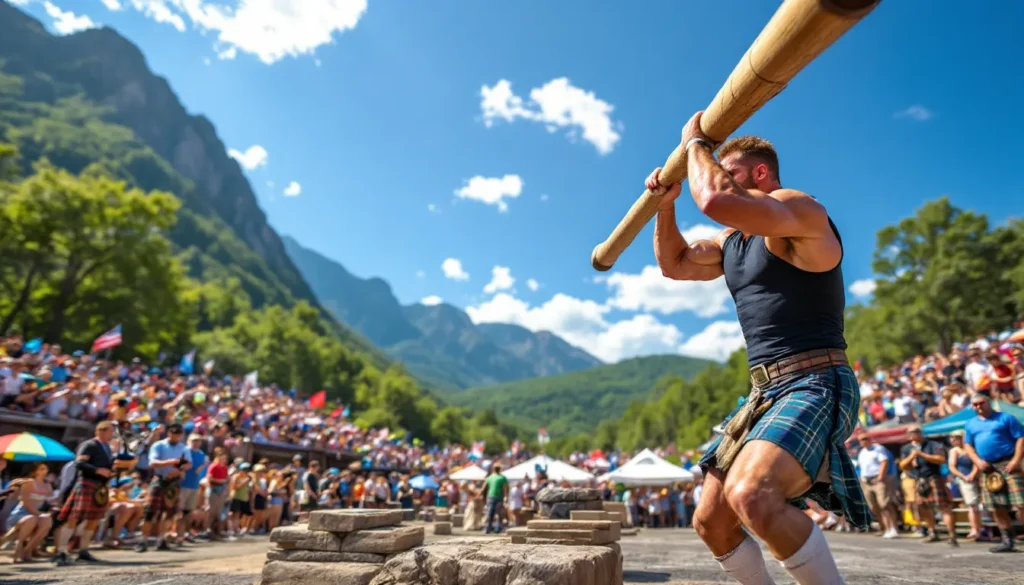
Caber Toss remains the most iconic event. Competitors lift a tapered wooden pole (typically 19-20 feet long, weighing 100-150 pounds depending on competition class) and attempt to toss it so it flips end-over-end and lands pointing away from the tosser. It’s pure leverage and timing, get the angle wrong by a few degrees and the whole attempt fails. Think of it as executing a perfect combo with strict timing requirements.
Stone Throws come in multiple variants. The “Braemar Stone” (16 pounds) and “Shot Put” style competitions test explosive hip drive and arm extension. There’s also the “Open Stone” (22 pounds), which separates strong competitors from truly elite ones. Athletes can achieve 40+ foot distances, with technique mattering as much as raw strength.
Hammer Throws (16, 22, or 56 pounds depending on class) combine rotational power with controlled release. The 56-pound hammer throw is particularly grueling, watching an athlete generate enough momentum while maintaining control never gets old.
Weight Throws include the “Light Hammer” (28 pounds) and “Heavy Hammer” (56 pounds), where competitors throw a weight attached to a handle. These events strip away technique complexity and emphasize pure explosive power.
Tug of War demonstrates team coordination and sustained strength, with four-person or eight-person teams competing based on weight class. This is where strategy enters, knowing when to push maximum effort versus pacing yourself for a longer pull.
Each athlete typically competes in multiple events, and rankings accumulate across the day to crown overall champions. Prize money varies by event and athlete class (amateur versus professional).
Cultural Performances And Entertainment
While strength competitions form the backbone, the Highland Games wouldn’t exist without cultural programming. Bagpipe bands perform throughout the day, with both solo pipers and full massed bands creating the distinctive soundscape that defines these events. The pageantry isn’t superficial, bagpipes are central to Scottish cultural expression, and hearing dozens of pipers in synchronized performance is genuinely moving.
Scottish dancing competitions feature performers executing traditional steps and formations with impressive precision. Highland dancing, in particular, demands flexibility, strength, and rhythm, it’s athletic performance disguised as cultural tradition. Sword dancing (dancing over crossed swords on the ground without touching the blades) requires the kind of foot-eye coordination that would impress esports commentators.
Clan gatherings and genealogy tents allow attendees to explore Scottish heritage, connect with clan associations, and learn about their own ancestral connections. The festival isn’t exclusively about competition, it’s fundamentally about community and shared cultural identity.
Merchant vendors sell everything from authentic Highland clothing to Scottish food, crafts, and memorabilia. The atmosphere resembles a convention floor meets outdoor festival, with designated areas for different activities.
Food, Music, And Community Experience
The food at Highland Games captures Scottish culinary tradition while accommodating modern festival-goer expectations. You’ll find Scottish staples like haggis (ground offal mixed with oats and spices, typically served with mashed potatoes and rutabaga), meat pies, sausages, and bannock bread alongside standard American festival fare. If you’ve never tried haggis, the festival provides a judgment-free opportunity to experience authentic Scottish cooking.
The community experience distinguishes Highland Games from typical sports events. Clans set up gathering areas where members wear traditional tartan, participate in competitions together, and celebrate their shared heritage. Even if you’re not affiliated with a specific clan, the inclusive atmosphere means you’re welcomed into conversation and tradition. Families camp or settle into nearby towns, creating multi-day festivals around the event rather than single-day visits.
Music extends beyond bagpipes. Highland bands, folk musicians, and traditional performers rotate through entertainment stages throughout the day. The soundscape at a well-run Highland Games is constant, you’re never more than a few hundred feet from live music in some form. This creates a festival atmosphere that keeps energy high even during competition downtime.
The competitive spirit extends to spectators. People cheer for athletes representing their clans, regions, or countries with genuine passion. This isn’t manufactured hype, it’s authentic community investment in outcomes. Gamers familiar with esports crowds will recognize that same intensity, just focused on traditional athletic competition.
The merchandise and vendor areas reflect both tourism and cultural commerce. You can purchase authentic Highland dress components, weapons replicas (broadswords, dirks), Scottish crafts, and genealogy services. The commercial aspect coexists naturally with the cultural one, similar to how gaming conventions blend fan culture with product sales.
Planning Your Visit: Tickets, Travel, And Logistics
Ticket pricing for the Celtic Classic typically ranges from $20-30 for general admission, with premium seating options available for $40-60. Kids often receive discounts, and group rates exist for larger parties. Check the official event website for current year pricing, as costs fluctuate based on lineup and venue arrangements.
Maxwelton, North Carolina sits in the High Country region near the North Carolina/Tennessee border, roughly 4-5 hours from Charlotte and similar distances from Knoxville. If you’re flying, Charlotte Douglas International Airport offers the most convenient access, with rental cars readily available. The drive from Charlotte follows I-40 West then scenic mountain highways, the route itself offers views worth the travel time.
Parking at the event is typically free or low-cost, with designated parking areas that fill early. Arriving by 8 AM ensures convenient parking near the grounds. If you’re staying overnight, planning ahead is essential, nearby hotels fill weeks in advance during festival season.
Platform Details: The Celtic Classic operates as an in-person event with no streaming options, so attendance requires physical presence. There’s no mobile app, so download the schedule and map information beforehand if the event website provides these.
Accommodation And Nearby Attractions
Banner Elk and Blowing Rock are the closest towns with hotel options, located 10-20 minutes from the festival venue. Hotels range from budget chains ($80-100 per night) to upscale resorts ($150-200+). Book accommodations 2-3 months in advance during summer, as mountain tourism peaks July-August.
Camping provides a festival-authentic experience. Many attendees camp on or near the grounds, creating a multi-day festival atmosphere. If you’re comfortable with rustic camping, this offers budget savings and cultural immersion that hotel stays can’t match.
Nearby attractions justify extending your visit. Grandfather Mountain offers hiking, scenic drives, and wildlife viewing. The Blue Ridge Parkway provides stunning scenic driving with numerous pull-off points and short hikes. Blowing Rock, located minutes from the festival, features shopping, dining, and attractions like the Hans-Flannery Jewel Box and Mystery Hill.
Linville Falls and Linville Gorge offer dramatic natural scenery worth exploring if you’re staying multiple days. The entire region rewards outdoor exploration, making it an ideal location for a weekend trip combining festival attendance with mountain recreation.
Virtual And Gaming Connections To Highland Games
While Highland Games are definitively real-world events, gaming culture has increasingly intersected with Celtic heritage and competitive traditions. Several games explore Highland themes, from strategy games set in Scottish landscapes to sports games featuring strength competition mechanics.
The competitive structure of Highland Games mirrors esports in meaningful ways. Athletes specialize in certain events, accumulate rankings across competitions, and compete in seasonal circuits. Prize pools for professional Highland Games athletes have grown significantly, with elite competitors earning six-figure incomes annually, competitive legitimacy that esports audiences understand intuitively.
Recent gaming coverage has increasingly featured strength sports and unconventional athleticism. Gaming journalism platforms now cover esports adjacent cultural events and traditional sports with fresh perspectives, recognizing that gamers care about competitive excellence regardless of medium. The underlying appeal, watching elite competitors execute perfect technique under pressure, remains consistent whether you’re watching a speedrunner navigate a game’s mechanics or an athlete toss a 100-pound pole.
For content creators and streaming communities, Highland Games offer untapped coverage potential. The visual spectacle, clear competition structure, and narrative potential (underdog athletes, massive throws, dramatic failures) translate well to streaming formats. Some gamers have discovered Highland Games through YouTube content creators who cover unconventional sports and competitions.
The gaming industry’s growing recognition of esports as legitimate competition has created crossover interest in traditional competitive formats. Gamers who understand “meta” and competitive optimization recognize those same principles at work in Highland Games, athletes optimizing technique, equipment selection, training regimens, and mental preparation to achieve fractional performance improvements.
If you’re looking to expand beyond standard gaming entertainment, attending Highland Games provides competitive sports viewing that offers genuine unpredictability and human drama. There’s no RNG determining outcomes, just skill, preparation, and execution, which resonates deeply with competitive gamers who respect mechanical excellence.
Conclusion
The Celtic Classic Highland Games represent something increasingly rare in modern entertainment, authentic cultural celebration combined with genuinely competitive athletics. For gamers accustomed to virtual worlds and esports broadcasts, attending a Highland Games event offers a reset: physical competition, unpredictable outcomes, and community celebration that gaming, but immersive, can’t fully replicate.
Planning your 2026 visit requires booking accommodations early, arranging travel to North Carolina, and budgeting for tickets and food. The late July/early August timing provides optimal weather and access to the full festival experience. Whether you’re seeking authentic Scottish culture, competitive sports thrills, or simply a unique travel experience, the Celtic Classic delivers across all dimensions.
The Highland Games won’t feel like gaming, and that’s precisely the point. They offer real stakes, genuine community, and the kind of live energy that makes recorded or virtual competition feel somehow diminished by comparison. If you’re a gamer willing to step outside the digital realm for a weekend, the Celtic Classic Highland Games deserves consideration as your next major trip.