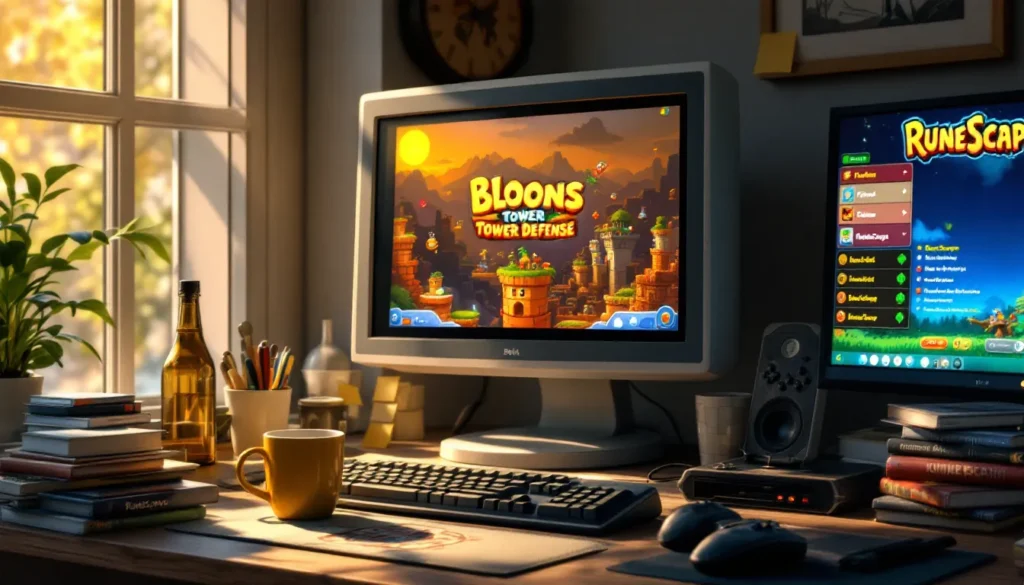
Remember when gaming meant loading up a browser, no installation required, no graphics card needed? Classic browser games built an entire generation’s gaming foundation. They didn’t need cutting-edge hardware or massive downloads, just a few kilobytes, some clever design, and the ability to hook you for hours. Flash games, Shockwave titles, and early web-based experiences defined a unique era of gaming that somehow managed to be both simpler and more creative than what we expected from the medium. Today, in 2026, those games still matter. Not as nostalgia bait, but as proof of concept: exceptional gameplay design doesn’t require bleeding-edge technology. Whether you’re chasing that Runescape grind from 2005 or discovering Pogo classics for the first time, classic browser games remain surprisingly engaging, and increasingly accessible as preservation efforts expand.
Key Takeaways
- Classic browser games proved that exceptional gameplay design doesn’t require cutting-edge technology, establishing design principles still fundamental to modern gaming in 2026.
- The Flash and Shockwave era democratized gaming by removing barriers to entry, making games instantly playable without installation or expensive hardware, and creating a meritocratic distribution model that influenced today’s indie gaming.
- Iconic classic browser games like RuneScape, Bloons Tower Defense, and Plants vs. Zombies succeeded through mechanical excellence, tight controls, and fair progression systems rather than visual spectacle or production value.
- Preservation efforts including Ruffle emulation, Internet Archive collections, and HTML5 conversions ensure classic browser games remain playable today, protecting gaming’s cultural history from digital obsolescence.
- Classic browser games demonstrated that players invest thousands of hours into well-designed mechanics with accessible entry points, directly shaping modern free-to-play economics, streaming culture, and indie game design philosophies.
What Made Classic Browser Games a Cultural Phenomenon
Browser games hit different because they were genuinely free, instantly playable, and socially accessible in a way console or PC gaming wasn’t at the time. You didn’t need to convince your parents to buy a $300 system or justify a $60 purchase. You just opened a tab and started playing.
The barrier to entry was virtually nonexistent, which meant everyone, from hardcore gamers to casual office workers, could participate in the same gaming culture. This democratization fundamentally altered how people thought about games. Suddenly, gaming wasn’t a niche hobby reserved for dedicated enthusiasts: it was something you did between tasks, something your coworkers played during lunch breaks.
Another critical factor: the community-driven economy. Games like RuneScape created emergent social systems where players traded, collaborated, and competed without the rigid structures of traditional MMOs. The browser format meant servers could be simpler, which paradoxically made the player-to-player economy more interesting. Your success depended on understanding other players’ value systems, not just farming the optimal spawn points.
These games also thrived because developers couldn’t hide behind technology. With Flash and Shockwave, there was no way to mask poor game design with next-gen graphics. Every pixel had to earn its place. This forced developers to nail the fundamentals: responsive controls, meaningful progression, and compulsive gameplay loops. The constraints became creative catalysts. When you look at how classic games on Steam still pull players decades later, you’re seeing the direct result of developers who had to prioritize mechanical excellence over visual spectacle.
The Golden Era of Flash and Shockwave Gaming
The Flash era, roughly 2000 to 2015, was the peak landscape for browser gaming. Adobe Flash provided the technical foundation for thousands of games, and the simplicity of development meant anyone with programming knowledge could create something playable in weeks. Flash wasn’t sophisticated, but it was efficient.
Shockwave, Flash’s predecessor, powered earlier classics and offered similar accessibility. These technologies enabled rapid iteration. Developers could deploy updates without requiring players to download patches or reinstall anything. You just refreshed the page and the game evolved.
Sites like Miniclip, Newgrounds, and Armor Games became distribution hubs where developers could reach millions of players without publishing deals or Steam approval. The distribution model was revolutionary: if your game was good, people would play it. Popularity was meritocratic in a way modern app stores aren’t. No algorithms deciding your visibility, no pay-to-play feature placements, just word-of-mouth and community discovery.
Flash’s dominance created a specific game design language that still influences indie developers today. Tight controls, clear feedback loops, and minimal learning curves became standard expectations. Games like Bloons TD and Stick RPG demonstrated that shallow mechanics plus deep progression systems equals thousands of hours of engagement.
Of course, this era also brought security vulnerabilities that eventually led to Flash’s deprecation (officially ending support in 2020). But that technical limitation spawned something important: preservation efforts. Organizations and hobbyists began archiving and converting Flash games, ensuring the cultural record didn’t vanish. Sites now host playable versions converted to HTML5, maintaining these games for future players.
The legacy is concrete. Modern web games, browser-based esports platforms, and free-to-play economics all trace lineage back to what Flash developers figured out during this period. You see echoes in every successful indie game, if mechanics are tight and progression feels fair, players will stick around regardless of graphics fidelity. The My Arcade Go Gamer retro collection shows how deeply this design philosophy embedded itself into gaming culture.
Essential Puzzle and Strategy Games You Should Revisit
Casual Favorites That Defined a Generation
Puzzle and strategy games dominated browser gaming because they scaled difficulty naturally without requiring reflexes or hardware performance. These games proved that depth doesn’t require action: it requires thought.
Bloons Tower Defense (and its many sequels) set the tower defense template that influenced everything from Plants vs. Zombies to modern roguelikes. The original browser version stripped strategy down to fundamentals: positioning, timing, and resource management. No story fluff, no cosmetics, just pure mechanical gameplay. Newer versions expanded the formula, but the core appeal remained identical. The game respects your intelligence and your time.
Bejeweled popularized the match-3 mechanic that became ubiquitous across mobile and browser gaming. It’s almost quaint now, tap gems to match three in a row, clear the board, advance. But the feedback loop was perfect: every move felt consequential, and the difficulty curve was precisely calibrated. Players understood their mistakes immediately and wanted to retry.
Plants vs. Zombies translated tower defense mechanics into a different context and added charm that made it accessible to non-traditional gamers. Strategy game fans and casual players both found something to engage with. The game’s visual clarity and simple control scheme (click to place) meant grandparents and speedrunners could enjoy it simultaneously.
Puzzle Quest and its successors showed that RPG progression could attach to any game mechanic, including match-3 puzzles. By wrapping combat stats and character progression around puzzle gameplay, it created a hybrid that was more engaging than either element alone.
Scrabble-like games and word puzzles thrived online because multiplayer functionality made them social. Competitive Scrabble players who’d never owned a console suddenly had ranked ladders and seasons. The format didn’t innovate mechanically, but digitizing these games revealed their timeless appeal.
Mahjong variants (Mahjong Dimensions, Mahjong Solitaire) showed that classical tile games could carry thousands of hours of content through level design and minor mechanical tweaks. Pattern recognition as the core loop proved endlessly replayable.
These games worked because they understood constraints. No voice acting, no cinematic sequences, no story padding, just mechanical purity. When you’re stripped of every distraction except the core game loop, that loop has to be impeccable. The retro games collection includes many of these titles, and they still deliver the same satisfaction today.
What’s fascinating is how these designs aged better than “bigger” games with more elaborate systems. Bloons TD5 released in 2011 is still actively played. Try finding active communities in many 2011 AAA releases. The reason: mechanical depth scales better than graphical fidelity.
Action and Adventure Classics That Still Captivate
Action browser games proved that fast-paced, skill-based gameplay could work without demanding top-tier hardware. These titles prioritized tight controls and clear visual feedback over processing power.
Stick Fighter and stick-figure games, in general, became a genre unto themselves. The crude aesthetic wasn’t a limitation, it was a strength. By removing visual noise, these games made hit detection and attack timing crystal clear. You knew why you succeeded or failed, which is what separates engaging action games from frustrating ones.
Line Rider invented a game around drawing physics. You drew a track, and a stick figure sledded on it. Deceptively simple concept with massive depth as players figured out momentum, friction, and trajectory. The game had near-zero learning curve but infinite skill expression. Someone could play casually for 10 minutes or spend 40 hours perfecting a technical course.
Armor games titles like Swords & Souls combined RPG progression with action gameplay. You built a character, trained stats, and fought turn-based battles. The accessibility (no reflexes required) combined with the dopamine of progression meant these games kept people engaged across sessions. You didn’t need to be good at games to experience growth, you just needed to show up and grind.
Madness Combat and similar sprite-based action games showed that animation quality and frame-perfect gameplay could coexist in a browser format. The responsiveness of controls became the selling point rather than visual rendering. When an attack hits on frame 12 and you feel that impact, graphics quality becomes irrelevant.
Escape The Room games pioneered a genre that became foundational to modern puzzle games. Limited visuals, inventory management, and click-based interaction created a template for thousands of iterations. The games worked because they paced information release carefully, you had to explore, observe, and synthesize clues. Mechanical simplicity enabled psychological complexity.
The broader lesson: action browser games forced developers to prove that input-response latency and control precision matter infinitely more than visual fidelity. A stick figure with perfect controls beats a detailed character model with mushy input lag every time. Modern game designers still grapple with this truth.
Many of these action titles now live on through classic adventure games archives, where you can experience how innovative the action design really was. Looking at them through contemporary eyes reveals how much modern games overcomplicate what these designers achieved with minimal resources.
Multiplayer and Competitive Browser Experiences
Multiplayer browser games created social gaming ecosystems before “social gaming” was an industry term. These weren’t single-player experiences you optionally played online, they were designed around player-to-player interaction as the core loop.
RuneScape stands as the most significant browser-based MMO ever created. Even now, in 2026, RuneScape continues operating with active development, proving that the original design philosophy was fundamentally sound. The game didn’t require exotic graphics or physics engines: it required compelling progression, player agency, and community systems. You could engage with virtually any activity, combat, crafting, trading, PvP, at your own pace. No class-based limitations meant your character’s identity was defined by your choices, not a character sheet predetermined by the developers.
RuneScape’s economy was entirely player-driven. The Grand Exchange let players trade items, and that economy became as complex as real markets. Some players optimized farms, others managed trading routes, still others just played what interested them. The game supported multiple playstyles simultaneously.
Habbo Hotel created social spaces where players could customize rooms, host events, and build friend networks. The game mechanics were minimal, but the social infrastructure was sophisticated. It proved that player expression and community building could carry engagement independently of mechanical complexity.
Agar.io and similar .io games created hyper-competitive, zero-friction experiences. You spawned, immediately understood the objective (get bigger), and battled other players in real-time. These games supported tens of thousands of simultaneous players and had virtually no matchmaking, just throw everyone in the same arena. The emergent gameplay and player skill expression created engaging PvP with zero ranking systems.
Chess.com and Chess.org transformed how people played chess competitively. Instant opponent matching, rating systems, and tournament infrastructure moved chess from dedicated software to accessible browser experiences. The technology didn’t invent anything, it just made existing competition more convenient.
These multiplayer experiences proved something critical: players don’t need graphics or sound design to engage in meaningful competition. They need fair mechanics, skill expression, and interaction with other humans. That principle drives esports design today. According to gaming news outlets, the most successful competitive games across all platforms share this principle: mechanics-first design that lets player skill shine.
The competitive browser era also established streaming culture early. Players broadcast games like RuneScape on Twitch years before streaming became standard, creating a community around watching others play. That social element, the shared experience of watching someone grind content or attempt a PvP feat, became integral to how these games sustained engagement.
How to Play Classic Browser Games Today
Preservation Efforts and Modern Alternatives
Flash’s discontinuation in 2020 created a technical crisis for classic browser games. Browsers removed Flash support, which left thousands of games unplayable. But preservation efforts emerged rapidly.
Ruffle is an emulator that converts Flash code to WebAssembly, allowing Flash games to run natively in modern browsers. Developers and organizations (including Newgrounds and the Internet Archive) integrated Ruffle into their preservation infrastructure. This means you can play Flash games today without any special setup, they just work in current Chrome, Firefox, Safari, or Edge.
The Internet Archive’s Flash collection maintains thousands of archived browser games and animations. The collection includes preservation efforts for multiple game categories. You can search by title, developer, or era, and play directly from the archive’s interface.
Newgrounds (founded in 1995) continues operating and now hosts Flash games through Ruffle integration. It remains the largest repository of user-submitted Flash content. Many original developers still maintain accounts there and have re-released their games through the modern platform.
HTML5 conversions represent another preservation method. Developers and fans have converted popular Flash games to HTML5 code, which runs natively without emulation. Sites like Game Jolt and itch.io host these conversions, often alongside indie interpretations of classic games.
For specific titles, individual preservation efforts sometimes exceed broader archive work. RuneScape enthusiasts maintain private servers running older game versions. The original Habbo Hotel remains operational with active development. Some games lived long enough to transition to modern engines, Bejeweled exists across mobile, web, and consoles.
Steam carries DRM-free classic games alongside modernized re-releases. You’re getting access to the original code plus source material in some cases, which helps with long-term preservation.
The practical path forward: if you want to revisit a specific classic browser game, search for the title on the Internet Archive or Newgrounds first. Most will play immediately through Ruffle. If not found there, check itch.io or Game Jolt for fan conversions. This approach covers probably 95% of historically significant browser games.
For games with ongoing communities (RuneScape, Habbo Hotel), the official versions remain accessible. They’ve evolved, but you can still experience the core design that made them compelling decades ago. The retro games list provides context and recommendations for where to find specific titles.
One note: some preserved games exist in legal gray zones due to copyright issues or defunct publishers. That’s part of why preservation is happening through communities, if commercial incentives don’t support maintaining old software, enthusiasts fill the gap. Emulation and archival efforts represent the only way many of these games survive.
Why Classic Browser Games Matter to Modern Gaming
Classic browser games established design principles that define how we think about games in 2026. They proved that gameplay depth doesn’t correlate with graphical fidelity, that accessibility doesn’t mean shallow design, and that constraint breeds creativity.
Accessibility standards came directly from browser games. These titles ran on any hardware, required no installation, and had zero learning curve. Modern game developers seeking “accessibility” are basically trying to recreate what browser games did naturally. When a contemporary indie game boasts “runs on low-end hardware” or “pick-up-and-play gameplay,” they’re following patterns established 20+ years ago.
Free-to-play economics trace lineage back to how browser games monetized through ads, cosmetics, and battle passes. The model itself isn’t new: browser developers simply iterated faster and more transparently than traditional publishers.
Streaming culture and competitive gaming frameworks found early expression through browser-based multiplayer. The idea that spectating skilled players is entertainment emerged from watching RuneScape streamers and agar.io tournaments.
Cross-platform design started with browser games (they worked everywhere) and influenced how modern studios approach porting. If a game is designed well, it should translate across platforms with minimal compromise.
Roguelike and roguelite structures owe conceptual debts to browser games. When you can restart instantly with no friction, game design becomes about meaningful systems that work across runs, not one-time stories. That insight drove modern roguelike design.
Perhaps most importantly: browser games demonstrated that players care about playing, not about consuming. They revealed that the joy comes from moment-to-moment mechanical engagement, not from cinematics or production values. That’s the insight that shaped indie gaming culture and corrected some of AAA gaming’s excess.
For developers and players alike, studying classic browser games is essential cultural history. Game Rant and other gaming media frequently highlight how indie games recapture what made browser titles captivating, designers return to basics of tight mechanics and accessible design.
The longevity of these games (many still have thriving communities) proves something industry discourse often overlooks: games don’t become irrelevant because graphics age. They become irrelevant when design is shallow or mechanics don’t respect player time. RuneScape from 2005 is more playable today than most AAA games from 2005. The difference? One was built on mechanical principles: the other relied on technical novelty.
Classic browser games represent a philosophical statement about what makes games worth playing. In 2026, with industry trends toward “games as a service” and endless grind optimization, revisiting these titles offers a corrective. They ask: what if we just made something fun and trusted that would be enough?
Conclusion
Classic browser games weren’t a phase in gaming history, they were a proving ground for fundamental principles we’re still learning from. They established that great game design doesn’t require cutting-edge technology, that accessibility creates broader communities, and that players will invest thousands of hours into anything with solid mechanics and fair progression.
In 2026, these games remain playable, relevant, and actively celebrated. Preservation efforts ensure they won’t vanish into digital obscurity. Whether you’re revisiting Bloons TD for the thousandth time or discovering Flash classics through archival collections, you’re engaging with gaming culture at its most honest: design stripped of everything except what makes play engaging.
The browser gaming era taught us that constraints don’t limit creativity, they focus it. The next generation of developers will likely build on these foundations again, finding new ways to prove that exceptional gameplay design transcends technology and trends. Until then, these games serve as both entertainment and instruction manual for what gaming can be when mechanical excellence takes priority over everything else.