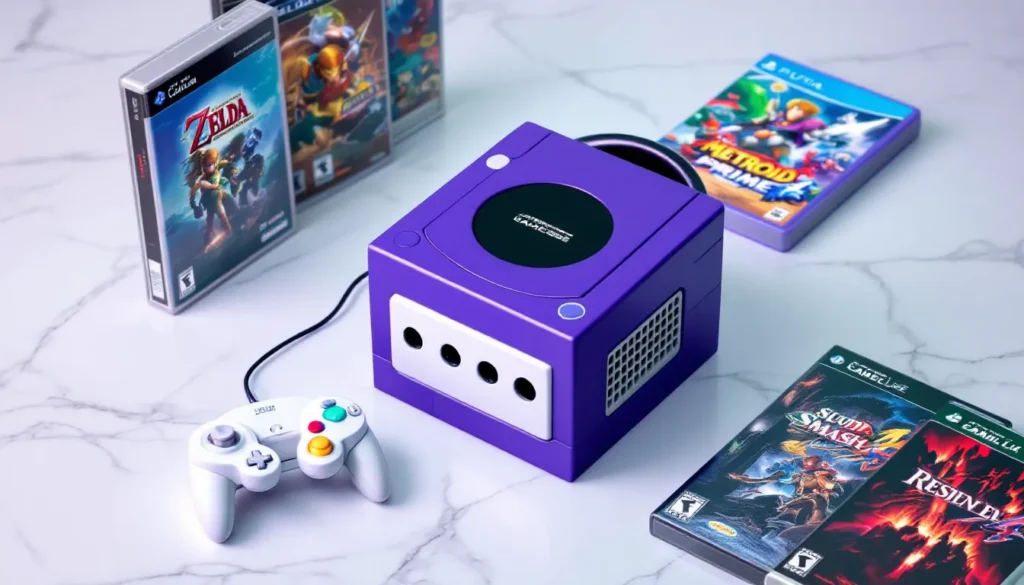
The GameCube’s purple plastic chassis still holds some of the finest games ever made. Released in 2001, Nintendo’s cube-shaped console carved out a legacy that refuses to fade, even as newer hardware dominates store shelves. While many gamers have moved on to current-generation platforms, the library of classic GameCube games represents a golden era of experimentation, creativity, and raw gameplay innovation that shaped how we play today. Whether you’re hunting for underrated gems or revisiting childhood favorites, these titles prove that age doesn’t diminish quality, it just makes rediscovering them feel even sweeter.
Key Takeaways
- Classic GameCube games prioritize intentional game design and artistic style over raw processing power, making them age better than many contemporary titles from the early 2000s.
- Iconic games like The Legend of Zelda: The Wind Waker, Metroid Prime, and Resident Evil 4 established design standards that modern games still follow today, proving innovation transcends hardware limitations.
- Super Smash Bros. Melee remains one of gaming’s deepest competitive experiences, with an active tournament scene two decades after release thanks to frame-perfect mechanics and character variety.
- Playing classic GameCube games in 2026 is more accessible than ever through emulation, modern ports, backwards-compatible Wii consoles, or original hardware with upscaler support.
- Beyond major franchises, hidden gems like Chibi-Robo, Viewtiful Joe, and Fire Emblem: Path of Radiance showcased Nintendo’s willingness to experiment and create distinct gameplay experiences.
- The GameCube library’s emphasis on gameplay depth, art direction, and creative risk-taking shaped the industry and continues to influence indie developers and modern game design philosophy.
Why GameCube Games Still Matter Today
Classic GameCube games stand as proof that great design transcends hardware limitations. These games weren’t built around graphical benchmarks or processing power, they were crafted with intentional mechanics, smart art direction, and gameplay depth that keeps players engaged years later.
The GameCube era hit a sweet spot in industry history. Developers had enough technical freedom to carry out complex ideas, but not so much that production budgets spiraled into the multi-million dollar territory we see today. This meant smaller teams could take creative risks. Games felt distinct, bold, and willing to experiment with control schemes, visual styles, and narrative structure in ways that modern AAA design often avoids.
Today’s gaming landscape tends toward proven formulas and iterative sequels. Revisiting classic GameCube titles offers something increasingly rare: experiences that feel genuinely different from what’s on store shelves right now. The emulation community and re-releases have also made accessing these games easier than ever, removing the barrier of hunting down original hardware.
Beyond nostalgia, these games hold technical and design lessons that modern developers still study. Titles that released two decades ago continue earning solid scores on aggregated review platforms and remain benchmarks for what great game design looks like. They’re not relics, they’re blueprints.
Action And Adventure Classics
The GameCube established itself as an adventure machine, hosting some of the most imaginative action titles Nintendo has ever greenlit. This category represents the console’s strongest lineup, blending technical achievement with unforgettable experience design.
The Legend Of Zelda: The Wind Waker
The Wind Waker remains one of the most divisive entries in the Zelda franchise, and one of the most rewarding. Released in 2002, this game swapped the gritty realism many fans expected for cel-shaded visuals that made players question Nintendo’s direction immediately. Two decades later, those graphics look timeless while contemporary realistic games from that era feel dated.
The sailing mechanic initially felt tedious to critics, but it’s actually brilliant world design. Crossing the ocean between islands creates natural pacing breaks, builds anticipation, and makes the world feel vast and lived-in. Combat rewards timing and positioning over button mashing. Puzzles demand genuine problem-solving. The story, told with charm and surprising emotional depth, holds up better than most narrative-heavy games from the early 2000s.
Version note: The 2013 Wii U remaster added quality-of-life improvements like faster sailing and quicker item swaps. If you’re emulating on PC or playing on original hardware, these changes are noticeable but not essential to enjoying the core experience. The GameCube original runs at 480p in 4:3 aspect ratio, while the Wii U version supports widescreen and higher resolution scaling.
Metroid Prime
Metroid Prime pulled off something that seemed impossible: translating Samus Aran’s 2D side-scrolling adventure into a first-person perspective without losing what made the franchise special. Released in November 2002, this was a genuine risk, and it paid off completely.
The game nails the isolation and exploration that defined the original Metroid. First-person perspective makes scanning the environment for secrets feel natural. Weapon-switching and puzzle-solving maintain the series’ methodical pacing. Combat demands awareness of your surroundings and careful aim. The HUD (heads-up display) stays diegetic, you’re looking through Samus’s visor, and the UI reflects that.
There’s a reason gaming media outlets still recognize this as one of the best reinventions in gaming history. It proved that first-person perspective could work for exploration-focused adventures, and the influence shows in games like Outer Wilds and modern Zelda titles.
Technical details: The GameCube version targets 60 FPS and mostly holds it, with occasional dips during busy scenes. The Wii version included motion controls for aiming, which some players found superior. For pure original experience, the GameCube version is the baseline.
Resident Evil Series
The GameCube hosted not one but two major Resident Evil exclusives that fundamentally shaped the franchise: Resident Evil (2002, a remake of the first game) and Resident Evil 4 (2005).
The 2002 Resident Evil remake didn’t just update the original, it reconstructed it with modern design philosophy. New puzzles, expanded areas, redesigned encounters, and the infamous Crimson Heads (regenerating zombies) created tension even veteran players couldn’t predict. The fixed camera angles, which sound dated now, actually function as an advantage. By controlling what players see, the developer crafts specific scares. It’s one of the best horror remakes ever made.
Resident Evil 4 essentially invented the modern third-person action-adventure template. Its over-the-shoulder camera perspective became the standard that games still follow today. Mid-combat weapon swapping, inventory management, and difficulty scaling options gave players genuine strategic options. The TMP (Tactical Machine Pistol) and shotgun feel distinct to use. Enemy design ranged from straightforward to genuinely unsettling.
RE4 proved that innovation doesn’t require cutting-edge technology, it requires rethinking how players interact with the system. Both games are available on modern platforms now, but the GameCube versions represent where design evolution happened.
Sports And Racing Standouts
The GameCube’s arcade-focused library extended beyond action games into sports and racing, where the console delivered some of the most chaotic and fun titles Nintendo has ever made.
Mario Kart: Double Dash
Mario Kart: Double Dash (2003) remains the series’ most experimental entry. Instead of the standard kart-racing formula, double dash introduced two characters per kart: a driver and an item user. This created genuine strategic depth. Do you prioritize a heavy character for raw speed, or pick a lighter driver for acceleration and handling?
The item system separates skilled players from casual ones. Special items, unique to each character pairing, require timing to deploy effectively. Yoshi and Daisy have eggs you throw backward for surprise hits. Mario and Luigi launch fireballs with delay. Learning each character’s specific strengths transforms the game from “throw items randomly” to “execute a race strategy.”
Drift mechanics reward precision. Drifting at exactly the right moment triggers a speed boost, and chaining boosts separates first place from third. The GameCube controller’s analog stick provides the sensitivity needed for consistent drifting.
Four-player split-screen is where this game shines. Modern Mario Kart titles have refined the formula, but Double Dash remains the most chaotic and hilarious entry in the series. It’s pure arcade fun without worrying about perfect balance.
Super Mario Strikers
Super Mario Strikers (2005) took soccer and stripped away sim complexity in favor of arcade chaos. Each character has distinct stats, Bowser hits harder but moves slower, while Luigi is nimble but fragile. These differences aren’t slight mechanical tweaks: they fundamentally change playstyle.
Shot timing determines whether your attempt goes in or gets blocked. Charged shots are stronger but telegraph your intention. Tackles risk giving up fouls. The game encourages active participation throughout every play rather than letting the AI handle everything.
Multiplayer matches become genuinely tense. A good Mario Strikers session has the competitive energy of fighting games but with the accessibility of soccer. It’s been ported to Switch and modernized, but the GameCube original still holds up with its fluid animation and responsive controls.
F-Zero GX
F-Zero GX (2003) stands as the series’ peak. It’s brutally difficult, visually stunning, and mechanically tight in ways that make it essential for anyone interested in how arcade racing works.
The GX engine runs at 60 FPS at 1080i (GCN upscaler required, but emulation handles this), with no visual shortcuts. Track design demands precision, racing line precision, braking point precision, boost timing precision. A single mistake cascades. Hit a wall and you lose speed momentum. Overheat your engine by chain-boosting too aggressively and your machine slows.
Character ships aren’t just skins, they have distinct handling properties. Captain Falcon’s Blue Falcon is a balanced all-rounder. Samurai Goroh’s Fire Stingray handles like a truck but accelerates hard. Learning the fleet transforms how you approach 26 unique tracks.
The story mode is genuinely entertaining, with voice acting that commits fully to the absurdity. It’s aged surprisingly well because GX never tried to be photorealistic. The art style, bold colors, exaggerated shapes, clean lines, transcended hardware limitations.
Fighting And Party Games That Defined The Console
The GameCube became synonymous with multiplayer gaming, hosting competitive fighters and party games that still draw players together today.
Super Smash Bros. Melee
Super Smash Bros. Melee (2001) is arguably the GameCube’s most important game. It launched alongside the console in Japan and defined multiplayer gaming for an entire generation. More than two decades later, the competitive community is still active, still discovering new techniques, and still drawing tournament viewership that rivals modern fighting games.
Melee’s depth comes from mechanics that seem simple on the surface. Wavedashing, a technique combining air-dodging with precise controller inputs, allows advanced players to move in ways beginners can’t replicate. Short-hopping modifies jump height for faster approach options. Frame data (the number of animation frames for each move) matters desperately in competitive play. A move that’s safe on block versus one that leaves you punishable by two frames fundamentally changes matchup dynamics.
The roster of 26 characters (plus unlockables) ranges from low-tier to broken-overpowered. Fox, Falco, and Sheik dominate competitive play. Pichu and Wobuffet occupy low-tier purgatory. Yet even low-tier characters have dedicated players who’ve discovered tech that makes them viable.
Version note: Melee remains exclusive to GameCube. It’s the only Smash Bros. game that hasn’t been ported, re-released, or superseded on newer platforms. If you want the authentic original experience, original hardware or emulation are your only options. The game targets 60 FPS and maintains it in single and multiplayer modes (with some edge cases in four-player chaos).
The competitive infrastructure around Melee is robust. Major tournaments happen monthly. Gaming coverage outlets regularly cover top tournament results. Watching high-level Melee competition is mesmerizing, players execute frame-perfect inputs, read opponents three moves ahead, and demonstrate recovery options that look like magic to casual viewers.
Mario Party Series
The GameCube hosted three main Mario Party entries, Mario Party 4, 5, and 6. These games became party staples because they balance luck-based mechanics with genuine skill expression.
The board-game structure creates narrative arcs. Early turns feel relatively open. Mid-game tension peaks as players jockey for position. Final turns often come down to dice rolls that completely reshape the standings. This unpredictability is intentional, it keeps everyone invested until the final turn.
Minigames are where skill matters most. These aren’t throwaway content: they’re tight, fast-paced challenges that reward precision. Bumper Balls requires spatial awareness and timing. Shy Guy’s Jungle Jam punishes hesitation. Consistent minigame performance determines whether luck carries you to victory or derails your run.
The GameCube versions feature sharp visuals and responsive controls. Modern Mario Party has refined the formula, but the GCN entries remain the gold standard for “party game that doesn’t feel like a total coin flip.”
RPG Gems And Story-Driven Experiences
While Nintendo’s GameCube skipped mainline turn-based RPGs, it hosted several excellent story-driven experiences that offered depth and character development rivaling console RPGs from other manufacturers.
Fire Emblem: Path Of Radiance
Fire Emblem: Path of Radiance (2005 in North America) brought the tactical RPG series to console for the first time. Turn-based tactical combat, positioning units on a grid, managing weapon durability, and dealing with permanent character death, created strategic depth that appealed to franchise veterans and newcomers alike.
The story follows Ike, a reluctant mercenary thrust into continental conflict. Supporting cast members have distinct personalities and branching relationships. Conversations between battles develop character motivations beyond simple exposition. The writing avoids melodrama while maintaining genuine emotional stakes.
Permadeath (or “Classic Mode”) forces difficult decisions. Sending a leveled-up unit into danger risks losing them permanently. This creates tension, you care about individual soldiers because losing them has permanent consequences. Casual Mode removes this stakes, but Classic Mode is where the game’s design shines.
Combat rewards positioning and weapon selection. Axes deal heavy damage but have low accuracy. Swords are balanced. Lances offer good range. Pairing units for protection matters. Knowing when to advance aggressively versus defend cautiously separates dominant playthroughs from struggling ones.
Version availability: Path of Radiance remains exclusive to GameCube. It’s expensive on the secondhand market and hasn’t been re-released. Emulation is the most accessible option for new players. The game targets 30 FPS in battle scenes and cutscenes, with menus running faster.
Tales Of Symphonia
Tales of Symphonia (2003 in North America) delivered an action-RPG with real-time combat, meaningful story choices, and character development that made emotional investment feel earned rather than scripted.
The story spans a massive campaign, easily 60+ hours for a complete playthrough. Lloyd Irving starts as a idealistic protagonist and grows through genuine hardship and moral compromise. Supporting characters have personal quests that feel relevant rather than optional padding. Dialogue choices occasionally matter, creating the sense that your decisions ripple through the narrative.
Real-time combat replaces traditional turn-based systems. You control one character while AI partners execute commands. Combos chain together for greater damage. Unison Attacks allow coordinated special attacks when meter fills. The system is simple enough for casual play but deep enough for sequence-optimization at higher difficulties.
Dual audio (Japanese voice acting with English subtitles versus English voice acting) lets players choose their preference. Both versions are solid, though the original Japanese performances occasionally convey emotional nuance that gets lost in translation.
The Wii and PS3 received ports years later, but the GameCube version remains the original and still plays smoothly. Combat responsiveness is crisp, and loading times are acceptable.
Eternal Darkness: Sanity’s Requiem
Eternal Darkness (2002) remains one of gaming’s most ambitious horror experiments. It blends psychological horror with gameplay mechanics that actually support the psychological element rather than just creating atmosphere.
The Sanity Meter depletes when you witness disturbing imagery or encounter creatures. As sanity decreases, reality becomes questionable. The game employs fake glitches, menus appear corrupted, characters phase through walls, the UI inverts. These effects aren’t just visual flavor: they make players unsure whether something is intentional game design or an actual problem. This uncertainty creates genuine dread.
The game doesn’t hide its tricks. It explicitly warns you that it’s watching your playstyle. It threatens to delete your save. These moments break the fourth wall intentionally, subverting the relationship between player and game. It’s metatextual horror design done right.
Three playable characters across different time periods share a connected narrative. Switching between viewpoints reveals how events are connected. Story structure rewards attention to detail and historical knowledge.
Combat is deliberately clunky, your character feels exhausted and vulnerable rather than powerful. This supports the horror tone better than tight, responsive controls would. Survival-horror depends on making the player feel outmatched, and Eternal Darkness commits to that philosophy even when it feels inconvenient.
Availability: Eternal Darkness remains exclusive to GameCube. It’s become increasingly rare and expensive on the secondhand market. Emulation is realistically the only way new players will experience it. The game runs at 30 FPS with variable resolution, typical for GameCube horror titles prioritizing visual detail over frame rate.
Hidden Gems Worth Rediscovering
Beyond the mega-franchises and critical darlings, the GameCube hosted dozens of games that deserved more attention than they received. These aren’t obscure ROM hacks or region-locked exclusives, they’re legitimate releases that simply got overshadowed by bigger titles.
Chibi-Robo (2005) is a charming action-adventure where you play a tiny robot assistant completing household chores. The concept sounds mundane, but the execution is delightful. Every object interacts meaningfully. The story is genuinely heartwarming. It’s pure Nintendo creativity, the kind of experimental IP that gets greenlit as an indie game today, not a full commercial release.
Viewtiful Joe (2003) borrowed the cell-shaded visual style that made Wind Waker controversial and created a love letter to Saturday morning cartoons. Real-time action with slow-motion mechanics, speed-up effects, and zooming manipulation created combo-focused combat that rewarded experimentation. The visual style holds up because it prioritized art direction over graphical processing power.
Battalion Wars (2005) took the Advance Wars formula to 3D. Real-time tactical gameplay with unit management, resource conversion, and map control created something that felt fresh. It’s faster-paced than turn-based tactics but retains strategic depth. The Wii received a sequel, but the GameCube original launched the concept.
Eternal Darkness appears earlier in this guide because it’s essential, but honorable mentions include Geist (possession-based first-person puzzle solving), Skies of Arcadia: Legends (pirate-themed JRPG with airship exploration), and Pikmin (real-time strategy with gardening mechanics). All found audiences but could’ve been bigger with better marketing.
The GameCube library benefited from Nintendo’s willingness to experiment. Not every experiment succeeded, but the library is richer for the attempts. Many of these hidden gems influenced indie developers and modern designers who grew up with the console.
Browsing through comprehensive GameCube lists reveals how diverse the library actually is. Curated retro game compilations showcase this breadth. The console wasn’t just about Mario and Zelda, it was a platform for creativity.
How To Play Classic GameCube Games In 2026
Playing classic GameCube games in 2026 is easier than ever, though options vary based on your setup, budget, and preferences.
Original Hardware: Authentic GameCube consoles plus controllers, AV cables, and game discs remain available secondhand but have increased in price over the past several years. The original console outputs composite, S-video, or RGB video depending on your region. Upscaler devices (like GCHD or Carby) convert the signal to HDMI, making integration with modern displays practical. GameCube controllers are still manufactured officially for Smash Bros. purposes, so replacements are available. This approach costs $200-500 depending on condition and accessories.
Nintendo Wii: The backwards-compatible Wii plays GameCube discs through the digital port (not HDMI). This is cheaper than GameCube hardware but gives you less of the “original hardware” feel. Wii supports component cables for better video output than composite.
Dolphin Emulation: The Dolphin emulator runs GameCube and Wii games at 1080p or higher with texture filtering and graphical enhancements. Setup requires dumping your own legally-owned game discs (which involves modest technical effort), but emulation is free once configured. Dolphin handles widescreen hacks, netplay with other players, save state features, and controller customization. Most games run at 60 FPS or better on modern PC hardware.
Modern Ports and Re-releases: Many GameCube classics have been ported to Switch or other platforms. Wind Waker’s 2013 Wii U remaster made sailing faster and supports widescreen. Ocarina of Time and Majora’s Mask received Switch ports. The first Resident Evil got a remake in 2023. Mario Kart: Double Dash remains exclusive to GameCube, but other entries are available on Switch. These ports often improve quality-of-life features but sometimes lose the original’s feel.
Which option makes sense? Original hardware captures authentic nostalgia and the genuine controller feel, but costs money and requires real estate. Wii backwards compatibility is budget-friendly but slightly compromised. Emulation provides the best flexibility, upgraded visuals, and accessibility, it’s where most new players experience these games. Modern ports and re-releases are polished but sometimes miss what made the original special.
Regardless of your approach, the important thing is that classic GameCube games are playable and worth your time. They’ve aged better than contemporary games from other platforms because gameplay depth doesn’t expire, and art direction that prioritizes style over photorealism resists visual obsolescence.
Conclusion
The GameCube’s legacy extends far beyond a single console generation. Its library shaped what players expect from game design, influenced entire genres, and proved that innovation doesn’t require the most powerful hardware.
Whether you’re exploring these classics for the first time or revisiting childhood favorites, the quality is undeniable. From Wind Waker’s bold artistic vision to Melee’s mechanical perfection to Resident Evil 4’s reinvention of third-person action, these games deserve recognition as cornerstones of gaming history.
The ecosystem supporting GameCube games has only improved. Emulation is accessible. Ports bring these experiences to modern hardware. Original hardware communities remain active. Finding your gateway into classic GameCube titles is simply a matter of choosing your preferred platform and diving in. You’ll understand why a 25-year-old console still commands respect and attention from players, developers, and historians alike.