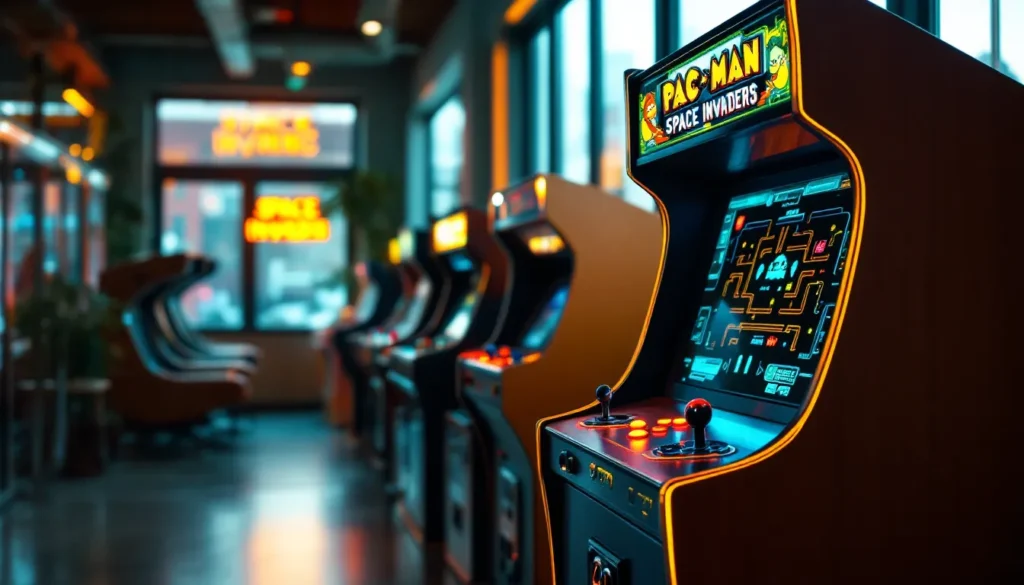
Classic arcade games weren’t just entertainment, they were a cultural phenomenon that shaped how we play, compete, and think about games today. Whether you dropped quarters into a cabinet in the ’80s or you’re discovering these legends for the first time in 2026, classic arcade games offer something modern titles often can’t: pure, distilled gameplay that rewards skill, muscle memory, and pattern recognition. These aren’t nostalgia trips padded with filler content: they’re mechanically tight, endlessly replayable, and genuinely fun. Understanding what made these games tick matters not just for history’s sake, but because they’ve influenced virtually every genre that came after them. Let’s dig into the titles that mattered, why they mattered, and how you can play them today.
Key Takeaways
- Classic arcade games succeeded through mechanical elegance, predictable patterns, fair difficulty curves, and honest game systems rather than flashy graphics or padding.
- The golden age of arcade gaming (1978–1986) established core design principles like clear goals, tight controls, and scalable difficulty that still influence modern games today.
- Essential classic arcade games like Pac-Man, Donkey Kong, Galaga, Space Invaders, Tetris, and Robotron represent different genres and remain mechanically sophisticated enough to justify repeated playthroughs.
- Playing classic arcade games today is more accessible than ever through emulation (MAME, RetroArch), curated collections on Switch and Steam, or affordable reproduction cabinets like Arcade1Up ($300–$500).
- Arcade culture transformed gaming by creating social spaces, establishing high scores as personal challenges, popularizing cheat codes, and legitimizing Japanese game developers in the global market.
- Build your classic arcade collection by starting with universally praised essentials, using curated collections as a foundation, exploring by preferred genre, and joining communities like r/cade for honest recommendations.
What Makes a Classic Arcade Game Truly Timeless
Not every arcade game from the ’70s and ’80s has aged well. Some feel clunky, others are locked behind obscure hardware or legal issues. But the truly timeless ones share specific traits that transcend their era.
First, there’s mechanical elegance. Games like Pac-Man and Donkey Kong operate on simple rules, move, avoid, collect, but execute them perfectly. There’s no bloat, no tutorial explaining obvious mechanics, no artificial padding. You understand the goal in seconds and spend hours mastering execution. The learning curve is forgiving but the skill ceiling is high.
Second, they rely on RNG and pattern memory in balanced measure. Games weren’t procedurally generated: enemies followed predictable patterns that skilled players could memorize and exploit. This rewarded practice and observation over reflexes alone, creating an accessibility sweet spot.
Third, the difficulty curve scales naturally. Early levels introduce mechanics. Mid-game increases pace and complexity. Late stages become genuinely grueling, but never unfair, you know exactly why you died. There’s no invisible damage multiplier or broken hitbox. Failure feels earned, which makes the next attempt feel necessary.
Finally, they’re mechanically honest. The screen shows everything you need. Controller input has zero lag. A pixel-perfect dodge works because you executed it precisely. These games don’t hide information or forgive mistakes gracefully: they’re direct conversations between player and game system. That directness is why speedrunners still compete on these titles and why casual players can still pick them up cold and have fun.
The Golden Age of Arcade Gaming
The arcade golden age typically spans 1978 to 1986, though the ripples extended well into the ’90s. This period saw the rise of the dedicated arcade cabinet as a cultural anchor in malls, pizza joints, laundromats, and arcades proper.
Space Invaders (1978) changed everything. It wasn’t the first arcade game, but it was the first true phenomenon. The game was simple: rows of aliens descending, you’re a cannon at the bottom, destroy them before they reach you. It created the shoot-’em-up template, demonstrated that arcade games could be profitable, and proved there was an audience for interactive play-for-quarters entertainment.
What followed was an explosion. Developers rushed to innovate. Asteroids (1979) showed that vector graphics could look sharp and create satisfying, physics-based destruction. Pac-Man (1980) proved that games didn’t need combat to be compelling, they needed personality and solid mechanics. Donkey Kong (1981) demonstrated that narrative (but basic) enhanced immersion, and that platforming could work as a core mechanic.
By the mid-’80s, the arcade industry was a multi-billion-dollar business. Arcades were social spaces where teenagers hung out, where high scores were earned and defended, where cheating myths (like the famous Konami Code) spread via rumor and playground gossip. The cabinets were everywhere, and the games were getting more ambitious: Tempest, Robotron: 2084, Gauntlet, and The Legend of Zelda (yes, it was an arcade first).
Then came the crash of 1983. Oversaturation, cartridge fatigue on home consoles, and the rise of games like E.T. damaged consumer confidence. Arcades survived where the home console market nearly collapsed, because arcades offered cutting-edge graphics and sounds that home hardware couldn’t match. By the mid-’80s, arcades bounced back stronger, with fighting games and advanced 3D cabinets reigniting interest.
This golden age wasn’t really about graphics or story. It was about establishing design principles that still hold: clear goals, tight controls, immediate feedback, and scalable difficulty. Every major genre, from shooters to fighters to action-adventure, began in these cabinets.
Must-Play Arcade Legends You Need to Experience
These are the games that defined genres, achieved cultural ubiquity, or remain mechanically sophisticated enough to justify repeated playthroughs. They’re the ones worth your time.
Action and Adventure Classics
Donkey Kong (1981) is the prototype for the platformer. Mario, originally called Jumpman, must ascend a construction site while avoiding barrels thrown by a giant ape. The level design is brilliant: each stage feels distinct, the difficulty curve is perfect, and the mechanic is instantly understandable. Even today, speedrunners compete on DK, and casual players enjoy it as a pure platformer.
Pac-Man (1980) is the simplest concept executed flawlessly. Navigate a maze, eat dots, avoid ghosts. The genius is in the ghost AI: each of the four ghosts has a distinct personality and behavior pattern. Red (Blinky) hunts you directly. Pink (Pinky) tries to ambush. Blue (Inky) uses unpredictable logic. Orange (Clyde) behaves erratically at range. Understanding these patterns transforms Pac-Man from random panic into strategic navigation. The power pellets are the only tools you have, use them to reverse the hunt. It’s perfect game design.
Dig Dug (1982) challenges players to navigate underground caverns, avoid enemies, and strategically collapse tunnels for protection or elimination. It’s less famous than Pac-Man or Donkey Kong, but it’s significantly deeper mechanically, your movement is constrained, enemy AI is aggressive, and resource management (air) adds tension. It’s worth hunting down.
Galaga (1981) is the Space Invaders successor that perfected the formula. Enemies dive-bomb instead of marching methodically downward. The challenge escalates intelligently: successive waves increase speed and alter attack patterns. The tractor beam mechanic (capture your ship, get it back for dual cannons) adds strategic depth. Galaga is pure, distilled action, shoot, dodge, progress.
Puzzle and Strategy Games
Tetris (1989, arcade version) is the game that proved puzzle games could achieve mainstream appeal. The premise is brutally simple: blocks fall, you rotate and position them to clear lines. The difficulty curve is perfect, early waves teach the mechanics, mid-game demands speed and spatial reasoning, late-game becomes a frantic race against gravity and RNG.
Puzzle Bobble (1994, also called Bust-A-Move) took match-three mechanics and added physics and precision aiming. Fire colored bubbles to match three or more and cause cascades. It’s easy to learn and impossible to master, with late stages requiring frame-perfect timing and bubble-drop prediction.
Puyo Puyo (1991) is Japan’s answer to Tetris. Drop colored puyos (small creatures), match four or more of the same color, trigger cascades. It’s faster-paced than Tetris, with more emphasis on chain reactions and offense (sending garbage blocks to opponents in versus mode). Competitive players still rank it higher than Tetris for skill expression.
Shooter Classics That Changed Gaming
Space Invaders (1978) established the template: enemies above, you below, dodge patterns while dealing damage. It’s mechanically simple but endless, there’s no “winning” Space Invaders, just playing until you die, trying to score higher next time. This loop defined arcade culture.
Galaga (mentioned above) perfected the vertical shooter formula. But the genre evolved significantly. Tempest (1981) rotated the perspective, you’re inside a tunnel, firing outward at enemies climbing toward you. It’s geometrically unique and demands precise aiming on all sides of the screen.
Robotron: 2084 (1982) is a dual-stick shooter (one stick for movement, one for direction of fire) where you’re surrounded by enemies in a confined arena. The game demands simultaneous awareness in all directions. It’s chaotic, frantic, and brilliant. Modern roguelikes and bullet-hell games owe their DNA to Robotron.
Defender (1980) is a horizontal shooter where you must defend civilians being abducted by aliens. It’s surprisingly complex, you can scroll the screen in either direction, giving players choices about engagement. Enemy variety is high, and the difficulty ramps aggressively.
1943: The Battle of Midway (1987) adds power-ups, varied enemy types, and stage progression to the vertical shooter. It’s more action-game than pure shmup, and the variety keeps it fresh through multiple playthroughs. The classic games on Steam library now includes this and many of these titles for modern platforms.
How to Play Classic Arcade Games Today
The beautiful thing about classic arcade games in 2026 is that playing them has never been easier or more legitimate. You have multiple paths depending on budget, preference, and authenticity priorities.
Emulation and Retro Collections
Emulation is the most accessible route. Emulators like MAME (Multiple Arcade Machine Emulator) can run thousands of classic games on PC, and the community maintains compatibility constantly. Legal gray area aside, emulation preserves games that would otherwise be inaccessible (many are out of print, original hardware costs thousands).
Most casual players prefer curated collections. Atari Classic Games: Relive the nostalgia is available on most platforms, featuring a solid lineup of Atari-era titles. Namco Museum and Arcade Classics Anniversary Collection are available on Switch, PlayStation, and Xbox, bundling 10-20+ games with quality emulation and modern features like online leaderboards, save states, and rewind functions.
Nintendo Switch is a particularly good platform for retro games. Games like Pac-Man 99, Tetris Effect: Connected, and the Nintendo Switch Online NES/SNES library mean you can access hundreds of classic titles for $50/year. The Switch’s portability also means you can play these games anywhere, which captures some of the original arcade appeal (though smaller screen).
PC is your deepest option. Steam has an entire category of classic games. Emulation tools like RetroArch unify multiple emulators in one interface, supporting everything from arcade to NES to SEGA Genesis with varying degrees of accuracy. The learning curve is steeper, but power users get frame-perfect emulation and advanced options.
One consideration: original hardware purists argue that emulation, even perfect emulation, lacks the cathode ray tube (CRT) visual experience and arcade cabinet controls. They’re not wrong, the feel is different. But it’s also not a dealbreaker for enjoying these games. The mechanics translate perfectly.
Arcade Cabinet Cabinets and Reproductions
If you want the authentic cabinet experience, reproduction cabinets are now a viable option. Companies like Arcade1Up manufacture compact arcade cabinets with 15-20 games each, licensed officially, selling for $300-$500. They’re not arcade-perfect, the joysticks and buttons are modern reproductions, the screens are flat-panels instead of CRTs, but they capture the form factor and social experience of standing in front of a machine.
Full-size reproductions exist but cost $1,000-$5,000+. For dedicated enthusiasts or arcade venues, they’re worth it. Machines from companies like Chicago Gaming or Arcade Legends use original artwork, higher-quality components, and authentic layouts.
There’s also the collector route: original cabinets. A functioning Pac-Man cabinet from 1980 can cost $1,500-$5,000+ depending on condition and rarity. Games like Tempest, Robotron, and Galaga often run higher. Repairs and maintenance require specialized knowledge, but the ROI (nostalgia, uniqueness) appeals to collectors. The My Arcade Go Gamer documentation covers how to identify and evaluate original machines.
The Cultural Impact of Classic Arcade Games
Classic arcade games didn’t just entertain, they fundamentally altered gaming culture, competitive play, and how we think about interactive design.
High scores became cultural currency. Before online leaderboards and achievements, high scores on arcade cabinets were posted on the machine itself. Beating your friend’s score, or your own personal best, became a social ritual. Initials immortalized on the machine. This mechanic transformed games from transient entertainment to personal challenges worth discussing for weeks. Modern achievements and trophies are direct descendants.
Arcades became social spaces. Unlike home console gaming (initially solitary), arcades were community hubs. You watched other players, learned techniques by observation, boasted about strategies. Competitive culture emerged organically. The arcade wasn’t just where you played, it’s where gaming culture happened. Shacknews and outlets like it trace modern esports directly back to arcade tournaments of the 1980s, where players competed for prize money and prestige.
Game design became more sophisticated. Arcade games proved that interactive entertainment could be art. Developers like Shigeru Miyamoto (Donkey Kong, Mario) elevated game design from simple mechanics to carefully orchestrated experiences. The constraints of arcade hardware forced elegance, you couldn’t hide behind flashy graphics or cinematic storytelling. Every pixel mattered. This legacy shaped how designers approach problem-solving even today.
Cheating became mythology. The Konami Code (up, up, down, down, left, right, left, right, B, A) spread via playground rumor, generating mysterious power-ups in games like Contra. Cheat codes became an expected feature of games. The idea that mastery involved hidden knowledge, passed peer-to-peer, created community and mystery before the internet existed.
Asian developers entered the conversation. Before arcades, Nintendo and Sega were toy and electronics companies. Donkey Kong (1981) proved that Japanese developers understood game design at a fundamental level. This success legitimized Japanese gaming companies, eventually leading to Nintendo’s dominance of the home console market after the ’83 crash. Without arcades, the gaming landscape would be unrecognizable.
Pattern recognition became a skill. Arcade games rewarded observation and memory. You’d die, learn, adapt, repeat. Speedrunners and high-score enthusiasts developed almost mathematical understanding of game behavior. This “read the game” mentality influenced genres like Souls games decades later, where pattern learning is central to success. GamesRadar+ has extensively documented how modern game design still reflects arcade-era principles of clarity and skill expression.
Building Your Classic Arcade Game Collection
Whether you’re starting fresh or expanding an existing collection, here’s a practical approach to building a meaningful library without very costly or wasting money on forgotten titles.
Start with the essentials. If you’re new to classic arcade games, begin with the universally praised titles: Pac-Man, Donkey Kong, Galaga, Space Invaders, Tetris, Tempest, and Robotron: 2084. These six represent different genres and design philosophies. They’re also the most accessible, available on virtually every platform and collection.
Use curated collections as a foundation. Rather than hunting down 50 individual games, buy one comprehensive collection (Namco Museum, Arcade Classics Anniversary Collection, Atari Classics). You’ll get the canon plus B-tier titles worth discovering. Spending $20-$30 once is smarter than buying games individually.
Explore by genre. After the essentials, identify which genres appeal to you. If you love action, dig into vertical shooters (Galaga, 1943, Vulgus). If you prefer puzzle games, explore Tetris variants and Puyo Puyo. If fighting games interest you, titles like Street Fighter II and Mortal Kombat arcade versions are essential.
Research before buying originals. If you’re considering original hardware, use resources like Eurogamer’s retrospective coverage and archived forums to understand which games hold value, which are prone to hardware failure, and which are overpriced. Original Pac-Man cabinets are common and relatively affordable ($1,500-$2,500). Tempest and Robotron are rarer and pricier ($3,000+).
Consider your space and budget. A full-size arcade cabinet requires 2’x2′ of floor space and weighs 300+ pounds. Reproduction cabinets from Arcade1Up are compact and lighter. Emulation on a PC costs $0-$100 depending on your hardware. Home consoles offer middle ground, convenient, affordable, quality emulation.
Don’t chase obscure titles immediately. Games like Gyruss, Joust, or Pengo are interesting but not essential. Play the big names first, develop taste, then explore deeper. Obscure games are often obscure for a reason (poor design, limited appeal, hardware glitches). The canon exists because those games earned it.
Join communities. Subreddits like r/cade and forums like Digital Press have collectors who share recommendations, repair advice, and honest assessments of games worth pursuing. They’ll save you money and time hunting for overpriced or overrated titles. Sega Video Game Consoles: documents the hardware ecosystem that birthed many arcade classics, providing context for understanding platform-specific collections.
Retro Fighting Games: Why They Still Captivate Gamers Today to see how the fighting game genre evolved from arcade roots, and consider whether fighting game collections align with your interests. Similarly, Switch Retro Games: Relive Your Childhood with Classic Titles Today offers a convenient modern platform if portability matters to you. Big Red’s Retro Games: provides another curated collection worth evaluating, and Xbox Classic Games: Relive ensures you’re not missing platform-exclusive availability.
Conclusion
Classic arcade games earned their place in gaming history not through nostalgia marketing but through mechanical excellence, design clarity, and the way they fundamentally changed how we think about interactive entertainment. They proved that games could be profitable, culturally significant, and genuinely fun without being complicated.
In 2026, with emulation perfected, physical collections abundant, and reproduction cabinets accessible, there’s no reason to miss these titles. Whether you’re chasing high scores like it’s 1985, learning why modern game design owes so much to these classics, or just looking for pure, distilled fun, the arcade legends are available and worth your time.
The barrier to entry is lower than ever. Pick a platform, Switch, PC, Steam, or a reproduction cabinet, pick a title from the must-play list, and spend an afternoon getting better at it. You’ll understand why gamers spent billions of quarters chasing high scores, and you might just chase a few of your own. That’s the timeless appeal of classic arcade games: mastery feels earned, failure feels fair, and the next quarter is always just one more try away.